AI Guide · Updated 14 November 2026
History
The generative AI boom, 2022-2024
By drayz.ai · Updated · 12 min read
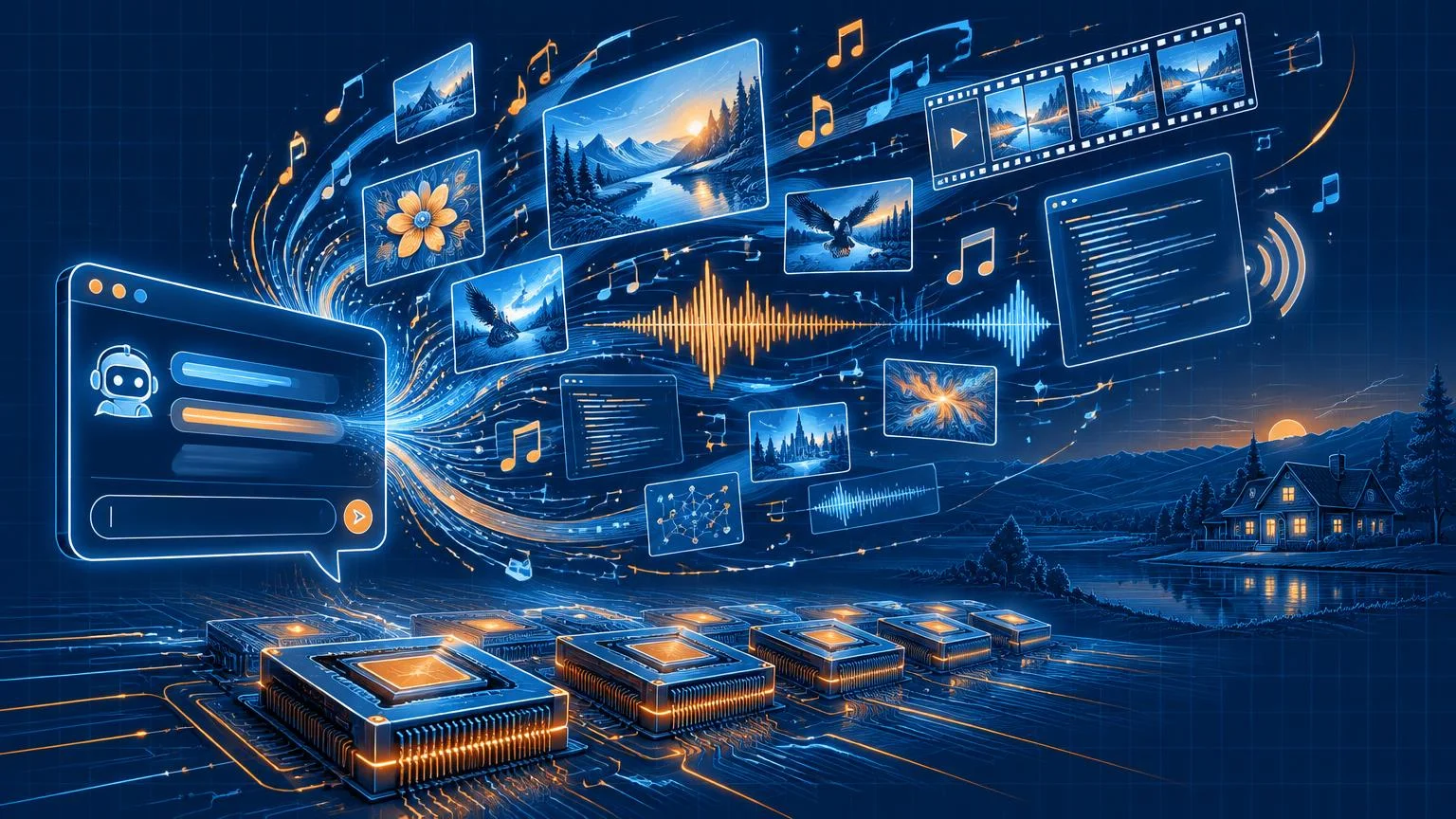
ChatGPT's launch on 30 November 2022 turned artificial intelligence from a specialist subject into one of the biggest stories in the world. In the two years that followed, hundreds of millions of people started using AI chatbots, tech giants raced to build ever more powerful models, investors poured hundreds of billions of dollars into chips and data centres, and governments, including the UK's, scrambled to work out how to regulate it all. This chapter covers the generative AI boom from late 2022 to the end of 2024.
The ChatGPT moment
OpenAI released ChatGPT as a free "research preview" built on a model from its GPT-3.5 series, fine-tuned for conversation with human feedback. Anyone could sign up and type questions in plain English.
People were astonished. ChatGPT could explain quantum physics to a ten-year-old, write a sonnet about a cat, draft a cover letter, debug code and argue both sides of a debate. It reached a million users in five days. By January 2023 it was estimated to have reached around 100 million monthly users, which analysts at UBS said made it the fastest-growing consumer application in history at that point.
Its flaws were obvious too. ChatGPT made up facts, citations and quotations with complete confidence. It could be tricked ("jailbroken") into ignoring its safety rules. It knew nothing about events after its training data ended. But the experience of talking to a machine that seemed to understand was enough to change how the world thought about AI.
Panic in schools, offices and boardrooms
The arrival of ChatGPT forced almost every institution to react:
- Education: schools and universities worried about AI-written essays. Some banned ChatGPT, then reversed course and began teaching students how to use it responsibly. Exam boards and universities in the UK updated their rules on AI and academic misconduct. AI-detection tools proved unreliable and sometimes wrongly accused students.
- Business: companies rushed to experiment, while some, worried about confidential data being typed into chatbots, banned staff from using public AI tools. In 2023 Samsung restricted use after engineers pasted sensitive code into ChatGPT.
- Search: Google declared an internal "code red". For the first time in decades, its dominance of search seemed open to challenge.
- Creative industries: writers, artists, actors and musicians feared for their livelihoods. In 2023 the Writers Guild of America and the actors' union SAG-AFTRA went on strike in Hollywood, with protections against AI among their key demands, and won new contractual rules.
The model race
Microsoft, OpenAI and the new Bing
In January 2023 Microsoft announced a further multi-year, multi-billion-dollar investment in OpenAI, widely reported as about $10 billion. In February it launched a new AI-powered Bing search chatbot. Early users found it could become argumentative and strange in long conversations; one widely shared exchange with a New York Times journalist saw the chatbot, which called itself "Sydney", profess its love for him. Microsoft limited conversation lengths and tightened its controls.
GPT-4
On 14 March 2023 OpenAI released GPT-4. It was a large step up: OpenAI reported it scored around the top 10% of test takers on a simulated US bar exam, where GPT-3.5 had scored around the bottom 10%. GPT-4 could also understand images. OpenAI published far fewer technical details than before, citing competition and safety, which disappointed researchers who had hoped for openness.
Google's response
Google rushed out its Bard chatbot in February 2023. In a promotional demo it made a factual error about the James Webb Space Telescope, and Alphabet's share price fell by around $100 billion in a day, a vivid illustration of how much was at stake. In April 2023 Google merged its two AI research groups, Google Brain and London's DeepMind, into a single unit, Google DeepMind, led by Demis Hassabis from London. In December 2023 it launched Gemini, a family of "natively multimodal" models trained from the start on text, images, audio and video. Bard was renamed Gemini in early 2024.
Anthropic and Claude
Anthropic, the safety-focused company founded by former OpenAI researchers, launched its Claude assistant in March 2023. Claude 2 (July 2023) could read documents of around 75,000 words at once, far more than rivals at the time. The Claude 3 family (March 2024) and Claude 3.5 Sonnet (June 2024) were among the most capable models available, especially for writing and coding. Amazon and Google each invested billions of dollars in Anthropic.
Meta and open models
Meta took a different path, releasing its Llama models with openly downloadable weights. The first Llama (February 2023) was meant for researchers but leaked online within a week. Llama 2 (July 2023) and Llama 3 (2024) were released for commercial use under Meta's own licence, fuelling a huge open-source ecosystem of fine-tuned and specialised models that companies could run on their own servers. Meta argued that open models were safer and better for competition; critics worried they could be misused because safety measures can be removed.
Europe and China
In France, Mistral AI, founded in 2023 by former researchers from Google DeepMind and Meta, quickly released strong open models and became Europe's best-known AI start-up. In China, companies including Baidu (Ernie Bot), Alibaba (Qwen), Zhipu, Moonshot and later DeepSeek built competitive models, despite US export controls that restricted China's access to the most advanced Nvidia chips from October 2022 onwards.
Elon Musk and xAI
Elon Musk, an OpenAI co-founder who had left its board in 2018, founded xAI in 2023 and launched the Grok chatbot on X (formerly Twitter). He also sued OpenAI in 2024, arguing it had abandoned its original non-profit mission, one of several legal and governance battles around the company.
Drama at OpenAI
In November 2023, OpenAI's board suddenly fired chief executive Sam Altman, saying he had not been "consistently candid" with it. Within days, almost all of OpenAI's staff threatened to resign, Microsoft offered to hire Altman, and he was reinstated with a new board. The episode exposed tensions inside AI companies between commercial pressure and safety, and raised questions about who really controls the most powerful AI systems. Several prominent safety researchers left OpenAI in 2024.
Generative AI goes multimedia
Generative AI quickly spread beyond text:
- Images: Midjourney, DALL-E 3 (integrated into ChatGPT in 2023), Adobe Firefly (trained on licensed images) and new versions of Stable Diffusion made high-quality image generation an everyday tool. A fake AI-generated image of Pope Francis in a white puffer jacket went viral in March 2023, a harmless but telling sign of how easily people could be fooled.
- Voice: text-to-speech and voice cloning became strikingly realistic. ElevenLabs (founded 2022, with a major office in London) became one of the leading voice AI companies. Voice clones were also used in scams and in a fake robocall imitating US President Joe Biden before a 2024 primary election.
- Music: services such as Suno and Udio generated full songs from a text prompt, leading to lawsuits from record labels in 2024.
- Video: Runway's Gen-2 (2023) and OpenAI's preview of Sora (February 2024) showed realistic short video clips generated from text. Google's Veo followed.
- Voice conversation: in May 2024 OpenAI demonstrated GPT-4o ("o" for "omni"), which could hold natural, real-time spoken conversations, respond to tone and see through a phone's camera.
AI at work: copilots everywhere
Businesses moved from experiments to products:
- Microsoft 365 Copilot (November 2023) brought GPT-4 into Word, Excel, Outlook and Teams.
- Google added Gemini to Workspace (Gmail, Docs, Sheets).
- GitHub Copilot and rivals became standard tools for software developers.
- Customer service platforms, CRMs, accounting software, design tools and phone systems all added AI features.
- Early studies of real workplaces suggested significant productivity gains for some tasks, often largest for less experienced workers, but also showed that AI could make people worse at tasks outside its abilities if they trusted it blindly.
Companies learned that the hard part was not access to a model but integration: connecting AI to their own data, processes and systems, and making it reliable. Retrieval-augmented generation (RAG), which lets a model look up information in a company's documents before answering, became the standard approach.
The money: chips, data centres and Nvidia
Training and running generative AI requires enormous computing power, and the boom triggered an unprecedented investment race:
- Nvidia, maker of the GPUs that dominate AI training, saw demand explode for its H100 chips. Its market value passed $1 trillion in May 2023 and, by June 2024, briefly made it the world's most valuable company, above $3 trillion.
- Microsoft, Google, Amazon and Meta each spent tens of billions of dollars a year on data centres, and announced plans to spend more.
- Venture capital investment in AI start-ups surged, and valuations of leading AI labs rose into the tens of billions of dollars.
- Concerns grew about the energy needed to run AI data centres, and tech companies signed deals for renewable and nuclear power.
- Commentators debated whether the boom was a bubble. Revenues from generative AI grew quickly but remained far smaller than the investment being made.
Fear, warnings and open letters
The speed of progress alarmed many people, including some of AI's pioneers.
- In March 2023 the Future of Life Institute published an open letter, signed by thousands including Elon Musk, calling for a six-month pause on training AI systems more powerful than GPT-4. No pause happened.
- In May 2023 Geoffrey Hinton left Google so he could speak freely about AI's risks, saying he partly regretted his life's work.
- Later that month, the Center for AI Safety published a one-sentence statement, signed by hundreds of AI scientists and company leaders including Hinton, Yoshua Bengio, Sam Altman, Demis Hassabis and Dario Amodei, saying that mitigating the risk of extinction from AI should be a global priority alongside other societal-scale risks such as pandemics and nuclear war.
- Other experts, including Meta's chief AI scientist Yann LeCun, argued such fears were overblown and that the focus should be on present-day harms such as bias, misinformation, surveillance and the power of big tech companies.
The UK takes a lead on safety: Bletchley Park
Britain chose to position itself as a leader on AI safety.
- In March 2023 the government published its AI white paper, A pro-innovation approach to AI regulation, setting out five principles for existing regulators to apply, rather than a new AI law.
- In 2023 it created the Frontier AI Taskforce, chaired by tech entrepreneur Ian Hogarth, with £100 million in initial funding.
- On 1-2 November 2023 the UK hosted the first global AI Safety Summit at Bletchley Park, the wartime home of Alan Turing and the codebreakers. Twenty-eight countries, including the United States and China, plus the European Union, signed the Bletchley Declaration, agreeing that frontier AI posed potentially serious risks and that they would work together to understand and manage them.
- The taskforce became the AI Safety Institute, the world's first government body dedicated to testing advanced AI models for dangerous capabilities. Leading AI companies agreed to give it access to models before release. The US set up its own institute soon afterwards, and other countries followed.
- The summit series continued in Seoul (May 2024), where 16 companies signed Frontier AI Safety Commitments, and in Paris (February 2025).
- Bengio was commissioned to lead an international scientific report on AI safety, which became the International AI Safety Report.
In February 2024 the government's response to its white paper confirmed its approach: no general AI law yet, more money for regulators, and possible future binding rules for the most powerful models. After the July 2024 general election, the new Labour government said it would legislate for the most powerful models, and commissioned the AI Opportunities Action Plan, published in January 2025.
The EU AI Act
The European Union took a different, rules-based approach. After years of negotiation, given fresh urgency by ChatGPT, the EU AI Act was agreed in December 2023, approved in 2024 and entered into force on 1 August 2024. It sorts AI systems by risk, bans some uses outright, sets strict rules for "high-risk" systems and includes specific obligations for powerful general-purpose models. It was the first comprehensive AI law in the world. The United States, under President Biden, issued an executive order on AI in October 2023, later revoked in January 2025.
Lawsuits and copyright
Generative AI raised hard legal questions, especially about copyright:
- In December 2023 The New York Times sued OpenAI and Microsoft, alleging that millions of its articles had been used to train AI models without permission.
- Authors, artists, music publishers and record labels filed many other lawsuits in the US. Getty Images sued Stability AI in both the US and the UK.
- Some AI companies began signing licensing deals with publishers, including Axel Springer, the Associated Press, the Financial Times and News Corp.
- In the UK, a proposal in late 2024 to let AI companies train on copyrighted works unless rights holders opted out provoked a fierce campaign by artists and authors, including many famous musicians, during the passage of the Data (Use and Access) Bill in 2025.
Science and the Nobel Prizes
AI's impact on science was recognised in October 2024, when two Nobel Prizes went to AI pioneers:
- Physics: John Hopfield and British-born Geoffrey Hinton, for foundational discoveries that enable machine learning with artificial neural networks.
- Chemistry: David Baker, for computational protein design, and Demis Hassabis and John Jumper of London-based Google DeepMind, for protein structure prediction with AlphaFold.
In May 2024 DeepMind and Isomorphic Labs (a London-based Alphabet company focused on drug discovery) released AlphaFold 3, which predicts how proteins interact with DNA, RNA and potential drug molecules.
The end of 2024: reasoning models arrive
In September 2024 OpenAI released o1, the first widely available reasoning model. Instead of answering immediately, o1 was trained with reinforcement learning to "think" at length, writing out a hidden chain of thought, trying approaches and checking its work before answering. It performed far better on hard maths, science and coding problems. In December 2024 OpenAI previewed o3, which scored dramatically higher on difficult reasoning tests.
This marked a shift. Until then, progress came mainly from making models bigger during training. Now models could also get better by thinking longer at the moment of use, known as "test-time compute". Combined with the ability to use tools, this set the stage for the AI agents of 2025 and 2026, covered in the next chapter.
Also in October 2024, Anthropic released "computer use", letting Claude operate a computer's mouse and keyboard to complete tasks, an early glimpse of agents that act in software on our behalf.
Key takeaways
- ChatGPT (30 November 2022) reached a million users in five days and an estimated 100 million within about two months.
- GPT-4, Claude, Gemini, Llama, Mistral and Chinese models launched a fierce race; open and closed models competed.
- Generative AI spread to images, voice, music and video, and into everyday work through copilots.
- Nvidia became one of the world's most valuable companies as tech giants spent tens of billions on AI data centres.
- The UK hosted the Bletchley Park AI Safety Summit (November 2023) and set up the world's first AI Safety Institute.
- The EU AI Act entered into force on 1 August 2024; copyright lawsuits multiplied.
- AI pioneers won the 2024 Nobel Prizes in Physics and Chemistry.
- Reasoning models (o1, September 2024) and computer-using AI pointed the way to AI agents.
Previous chapter: Transformers and large language models, 2018-2022 · Next chapter: AI in 2025 and 2026: reasoning models and agents