AI Guide · Updated 14 November 2026
Artificial intelligence explained: the complete UK guide
By drayz.ai · Updated · 33 min read
Artificial intelligence (AI) is technology that lets computers do things that normally need human intelligence: understanding language, recognising images and speech, spotting patterns, making predictions, planning and taking decisions. Most AI in use today learns these skills from large amounts of data rather than following rules a programmer wrote by hand.
This guide explains AI from the very beginning to today, in plain English and from a UK point of view. It covers where AI came from, how it works, what it can and can't do in 2026, what it costs, the challenges and risks, the law, jobs, the environment and where it may go next. Each part links to a full chapter if you want to go deeper.
Key facts at a glance (UK, 2026)
- 35% of UK businesses with 10 or more employees used at least one AI technology in June 2026, up from about 12% in late 2023 (Office for National Statistics).
- Large language models such as chatbots are the most used type, by 18% of those businesses. Only 10% of adopters say they use AI extensively.
- Around 36% of UK workers say they use AI at work.
- Data centres used about 415 TWh of electricity worldwide in 2024, around 1.5% of global demand. The International Energy Agency expects that to more than double to about 945 TWh by 2030, mainly because of AI.
- The cost of training the largest AI models has grown about 2.4 times a year since 2016 (Epoch AI).
- The UK has no single AI Act. Existing laws (data protection, equality, consumer and product safety) apply, and regulators apply five cross-sector principles.
- The EU AI Act is in force, but its main "high-risk" rules have been pushed back to December 2027 and August 2028.
What AI is, and what it isn't
The phrase "artificial intelligence" was coined in 1955, in a proposal for a summer research project at Dartmouth College in the United States. The researchers behind it argued that learning, and every other feature of intelligence, could in principle be described so precisely that a machine could be built to simulate it. Seventy years later, that bold idea is still the best short description of the field: AI is the attempt to get machines to do the things we call intelligent when people do them.
In everyday use today, "AI" usually means one of three things:
- Machine learning systems that learn from examples. Your bank's fraud alerts, Netflix recommendations, spam filters and the face unlock on your phone all work this way.
- Generative AI, which creates new text, images, audio, video or code. ChatGPT, Claude, Gemini, Copilot, Midjourney and similar tools are generative AI.
- AI agents, which go a step further: they plan a series of actions and carry them out with tools, for example researching a topic, filling in forms, writing and testing software, or answering the phone and booking appointments.
It helps to be clear about what AI is not. Today's AI is not a digital person. It does not have feelings, and it does not "understand" the world in the way you do. A language model predicts what words should come next based on patterns in an enormous amount of text. That turns out to be powerful enough to write essays, explain physics and debug code, but it also means AI can be confidently wrong, can repeat biases in its training data, and can fail in ways a person never would.
AI is also not one single technology. It is a toolbox that includes statistics, logic, search, optimisation, probability, neural networks and robotics. Some of the oldest techniques, such as rule-based expert systems from the 1980s, still run quietly inside insurance, banking and manufacturing systems today.
Read the full chapter: What is artificial intelligence? Definitions, types and examples
The main types of AI
People divide AI up in several different ways. These are the ones you will hear most often.
Narrow AI, general AI and superintelligence
- Narrow AI (also called weak AI) does one job or a family of related jobs: recognising faces, translating languages, playing chess, predicting demand. Every AI system in commercial use is narrow AI, even if some of today's general-purpose models are very broad.
- Artificial general intelligence (AGI) describes a system that could learn and perform most intellectual tasks a human can, across many fields, at a human level or above. There is no agreed definition and no agreed test. Some AI company leaders say AGI could arrive within a few years; many researchers are sceptical. Treat confident predictions in either direction with caution.
- Superintelligence means AI that would outperform the best humans in almost every field. It is a hypothetical idea, but it is taken seriously in AI safety research because of the risks it could pose.
Rules versus learning
- Symbolic AI (sometimes called "good old-fashioned AI") represents knowledge as symbols and rules, such as "if the patient has a fever and a rash, consider measles". It is transparent and predictable but brittle: it breaks when it meets situations its rules don't cover.
- Machine learning learns patterns from data instead. It copes far better with messy, real-world information, but it can be harder to explain why it made a particular decision.
- Hybrid or neuro-symbolic approaches try to combine the two, for example a language model that calls a calculator or a database rather than guessing.
Predictive versus generative
- Predictive AI answers questions such as "Is this transaction fraudulent?", "Will this customer cancel?" or "How many staff will we need on Saturday?"
- Generative AI produces new content: a draft email, a product photo, a song, a summary of a 200-page report.
Learning styles
- Supervised learning learns from labelled examples ("this email is spam, this one isn't").
- Unsupervised learning finds structure in unlabelled data, such as grouping customers with similar buying habits.
- Reinforcement learning learns by trial and error, collecting rewards for good outcomes. It powered DeepMind's AlphaGo and is used to fine-tune chatbots and train robots.
- Self-supervised learning creates its own training signal from raw data, for example by hiding a word in a sentence and learning to predict it. This is how large language models are pre-trained.
A short history of artificial intelligence
AI has a longer history than most people realise, and Britain plays a central part in it. Here is the story in brief. The chapters linked below tell it in full.
Before computers: dreams of thinking machines
Stories of artificial beings go back thousands of years. Greek myths told of Talos, a bronze giant who guarded Crete. In 1206 the engineer Ismail al-Jazari, working in what is now south-east Turkey, described programmable automata including a musical band driven by water and pegs. In the 17th century the philosopher Gottfried Leibniz dreamed of a "calculus of reasoning" that would let people settle arguments by calculating.
In Victorian London, Charles Babbage designed the Analytical Engine, a mechanical general-purpose computer. Ada Lovelace, who wrote the first published algorithm for it in 1843, saw that such a machine could work on symbols as well as numbers, and might one day compose music. She also warned that it "has no pretensions whatever to originate anything", a debate about machine creativity that continues today. In 1854 George Boole, a self-taught mathematician from Lincoln, published The Laws of Thought, showing that logic could be written as algebra. Boolean logic now runs inside every digital chip.
Alan Turing and the birth of computing
In 1936 Alan Turing, then a young Cambridge mathematician, described a simple imaginary machine that could carry out any calculation that can be written as a step-by-step procedure. The "Turing machine" is still the foundation of computer science. During the Second World War Turing worked at Bletchley Park, where codebreakers used electromechanical "bombes" to break Enigma, and Tommy Flowers' Colossus, one of the first electronic computers, attacked German teleprinter codes.
In 1950 Turing published "Computing Machinery and Intelligence", which opens with the question "Can machines think?" He proposed the "imitation game", now called the Turing test: if a judge chatting by text cannot reliably tell a machine from a person, we should accept that the machine is thinking. He also predicted machine learning, suggesting it might be easier to build a "child machine" and teach it than to program an adult mind directly.
Early British computers soon ran the first AI programs. Christopher Strachey wrote a draughts (checkers) program for the Ferranti Mark 1 in Manchester around 1951-52, and Dietrich Prinz wrote a chess-problem solver for the same machine. In Bristol, the neuroscientist W. Grey Walter built "tortoise" robots that wandered towards light and returned to recharge, early examples of behaviour emerging from simple electronics.
Read the full chapter: From ancient automata to Alan Turing: the prehistory of AI
1956-1973: the golden age
The Dartmouth workshop of 1956 gave the field its name and its first heroes: John McCarthy, Marvin Minsky, Claude Shannon, Allen Newell and Herbert Simon. Newell, Simon and Cliff Shaw's Logic Theorist proved theorems from Principia Mathematica. Frank Rosenblatt built the Perceptron, a learning machine loosely inspired by neurons. Arthur Samuel's draughts program learned to beat its creator, and Samuel popularised the phrase "machine learning". Joseph Weizenbaum's ELIZA chatbot of 1966 imitated a therapist so convincingly that some users confided in it, which alarmed Weizenbaum. Shakey, built at the Stanford Research Institute, became the first mobile robot to reason about its own actions.
Optimism ran high. In 1965 Herbert Simon predicted that within twenty years machines would be able to do any work a person could do. That turned out to be badly wrong, and the gap between promises and results set up the first crash.
Read the full chapter: Dartmouth and the golden age of AI, 1956-1973
1974-1993: winters and expert systems
In 1973 the British government published the Lighthill Report, which concluded that AI had failed to deliver on its "grandiose objectives". Funding was cut in the UK, and US funding was squeezed around the same time. This period of disappointment became known as the first "AI winter".
AI recovered in the 1980s through expert systems: programs that captured the rules used by human specialists. XCON, built for Digital Equipment Corporation, configured computer orders and was reported to save the company tens of millions of dollars a year. Japan launched its ambitious Fifth Generation Computer project in 1982, and Britain responded with the Alvey Programme in 1983. In 1986 David Rumelhart, Geoffrey Hinton and Ronald Williams popularised "backpropagation", the training method still used by neural networks today.
Expert systems proved expensive to maintain and fragile outside their narrow area. When the market for specialised AI hardware collapsed in 1987, a second AI winter followed.
Read the full chapter: AI winters and the rise and fall of expert systems, 1974-1993
1993-2011: machine learning takes over
Quietly, AI changed direction. Instead of hand-writing rules, researchers increasingly let computers learn statistical patterns from data. Speech recognition, spam filters, search engines and recommendation systems all improved this way. In May 1997 IBM's Deep Blue defeated world chess champion Garry Kasparov. In 2005 Stanford's driverless car "Stanley" won the DARPA Grand Challenge by crossing 132 miles of desert. In 2009 Fei-Fei Li's team released ImageNet, a database of millions of labelled photos that would soon change everything. In 2011 IBM Watson won the US quiz show Jeopardy!, and Apple launched Siri.
Read the full chapter: The machine learning era, 1993-2011
2012-2017: the deep learning revolution
In 2012 a neural network called AlexNet, built by Alex Krizhevsky, Ilya Sutskever and Geoffrey Hinton, won the ImageNet competition by a huge margin, cutting the error rate from about 26% to about 15%. The secret was deep learning: neural networks with many layers, trained on graphics processing units (GPUs) originally designed for video games.
London became a world centre of AI. DeepMind, founded in London in 2010 by Demis Hassabis, Shane Legg and Mustafa Suleyman, was bought by Google in 2014. Its AlphaGo program beat Go champion Lee Sedol 4-1 in Seoul in March 2016, a feat many experts had thought was a decade away. In 2017 researchers at Google published "Attention Is All You Need", introducing the Transformer, the design behind almost every major language model since.
Read the full chapter: The deep learning revolution, 2012-2017
2018-2022: language models and the generative AI moment
Transformers trained on huge amounts of text, known as large language models (LLMs), improved rapidly. OpenAI's GPT-3 in 2020 had 175 billion parameters and could write convincing prose from a short prompt. DeepMind's AlphaFold 2 solved much of the 50-year-old "protein folding problem" in 2020; its creators Demis Hassabis and John Jumper shared the 2024 Nobel Prize in Chemistry with David Baker. Image generators such as DALL-E 2, Midjourney and Stable Diffusion arrived in 2022.
Then, on 30 November 2022, OpenAI released ChatGPT. It is estimated to have reached 100 million users within about two months, which at the time made it the fastest-growing consumer app in history. Generative AI went mainstream almost overnight.
Read the full chapter: Transformers and large language models, 2018-2022
2023-2026: the race, the regulators and the agents
Since ChatGPT, development has been relentless. Big technology companies and well-funded start-ups, including OpenAI, Anthropic, Google DeepMind, Meta, xAI, Mistral and Chinese labs such as DeepSeek, Alibaba (Qwen) and Moonshot, have released ever more capable models. They now handle text, images, audio and video, can read documents of hundreds of thousands of words at once, and increasingly "reason" step by step before answering.
Key milestones include:
- November 2023: the UK hosted the first global AI Safety Summit at Bletchley Park and set up the AI Safety Institute, renamed the AI Security Institute in 2025.
- August 2024: the EU AI Act entered into force, the world's first comprehensive AI law.
- October 2024: Nobel Prizes in Physics (John Hopfield and Geoffrey Hinton) and Chemistry (David Baker, Demis Hassabis and John Jumper) went to AI pioneers.
- Late 2024 to 2025: "reasoning" models that think through problems before answering, and open-weight models from China that matched leading US systems at far lower training cost, shook up the industry.
- January 2025: the UK published its AI Opportunities Action Plan, including "AI Growth Zones" for data centres.
- 2025-2026: AI agents that can use software, browse the web, write and run code and work for hours on a task became the main focus of the industry. Humanoid robots began moving out of the lab into warehouses, factories and the first homes.
- February 2026: the second International AI Safety Report, chaired by Turing Award winner Yoshua Bengio and written by more than 100 experts, found that capabilities were advancing quickly while safeguards still had significant gaps.
Read the full chapters: The generative AI boom, 2022-2024 and AI in 2025 and 2026: reasoning models and agents
| Year | Milestone |
|---|---|
| 1843 | Ada Lovelace publishes the first algorithm for Babbage's Analytical Engine |
| 1936 | Alan Turing describes the universal "Turing machine" |
| 1950 | Turing's paper "Computing Machinery and Intelligence" proposes the imitation game |
| 1956 | Dartmouth workshop names the field "artificial intelligence" |
| 1958 | Frank Rosenblatt demonstrates the Perceptron |
| 1966 | ELIZA, the first famous chatbot |
| 1973 | The Lighthill Report leads to UK AI funding cuts |
| 1980s | Expert systems boom; backpropagation popularised (1986) |
| 1997 | IBM's Deep Blue beats Garry Kasparov at chess |
| 2009 | ImageNet dataset released |
| 2012 | AlexNet starts the deep learning revolution |
| 2014 | Google buys London's DeepMind |
| 2016 | AlphaGo beats Lee Sedol at Go |
| 2017 | The Transformer architecture is published |
| 2020 | GPT-3 and AlphaFold 2 |
| 2022 | ChatGPT launches on 30 November |
| 2023 | Bletchley Park AI Safety Summit |
| 2024 | EU AI Act in force; Nobel Prizes for AI pioneers |
| 2025 | Reasoning models, AI agents, UK AI Opportunities Action Plan |
| 2026 | Agentic AI spreads; first humanoid robots ship to homes; EU high-risk rules delayed |
How modern AI works, in plain English
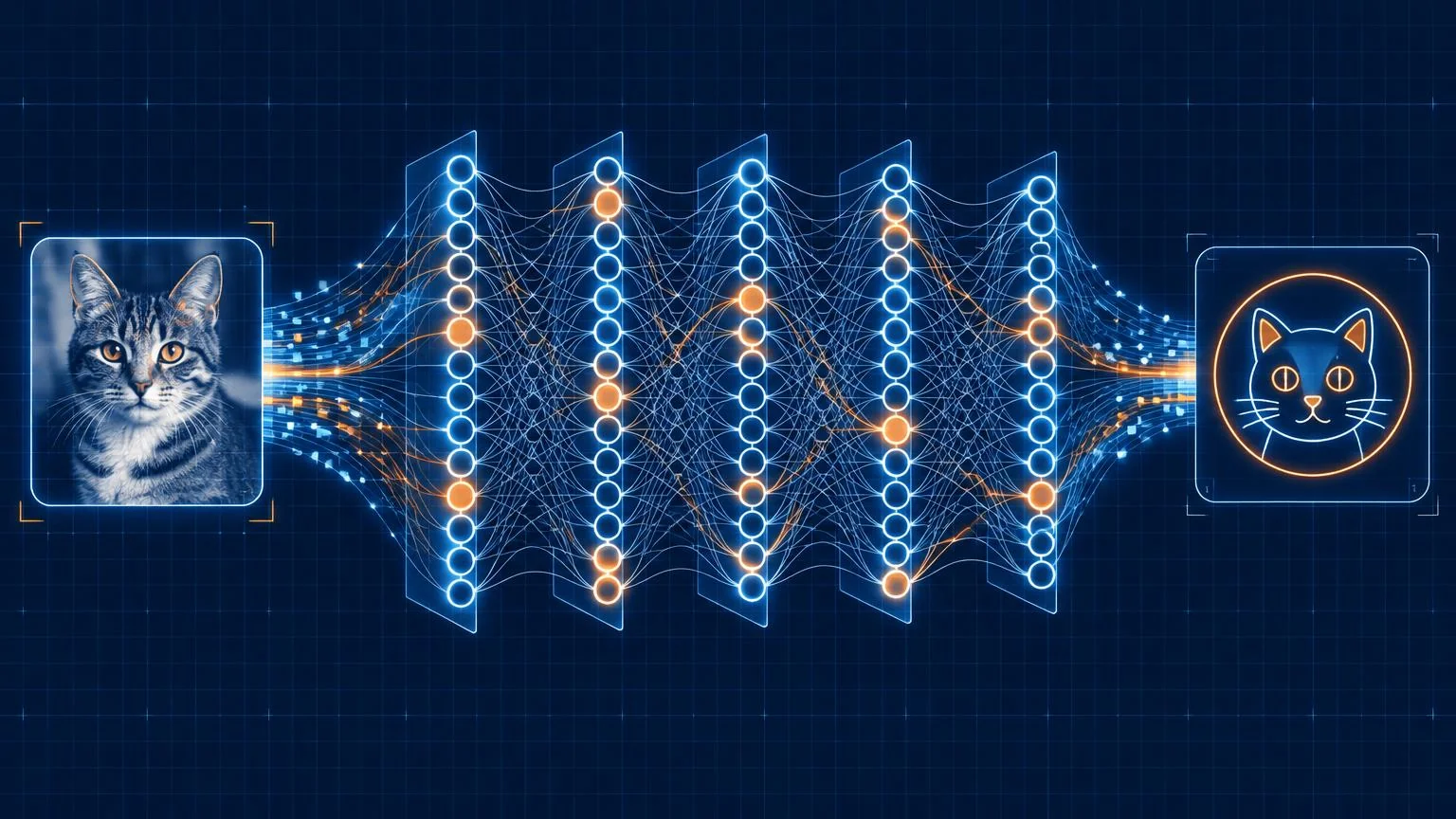
You don't need maths to understand the basic ideas behind today's AI.
Learning from examples
Imagine teaching a child to recognise cats. You don't give them a rulebook ("four legs, whiskers, pointy ears"). You show them lots of cats and lots of things that aren't cats, and correct them when they get it wrong. Machine learning works the same way. The computer makes a guess, measures how wrong it was, and adjusts itself slightly to be less wrong next time. Repeat that millions or billions of times and it becomes very good.
Neural networks
A neural network is a mathematical structure loosely inspired by the brain. It is made of layers of simple units ("neurons"), each of which takes some numbers in, multiplies them by adjustable weights, adds them up and passes the result on. A modern model can have billions or even trillions of these weights, also called parameters. Training is the process of finding good values for all of them, using an algorithm called backpropagation and a method called gradient descent, which nudges every weight in the direction that reduces the error.
"Deep" learning simply means networks with many layers. Early layers in an image model learn to detect edges and colours; later layers combine them into eyes, wheels or letters; the final layers recognise whole objects.
How a large language model writes
A large language model is trained on a vast collection of text (books, websites, code, articles and more) to do one thing: predict the next small chunk of text, called a token. To do that well across trillions of examples, it has to pick up grammar, facts, styles of reasoning and how ideas connect. When you ask it a question, it generates an answer one token at a time, each time choosing a likely next token based on everything so far.
After this "pre-training", developers fine-tune the model to be helpful, honest and safe, using human feedback and other techniques. Modern assistants are also given tools, such as web search, calculators or the ability to run code, so they can check facts and do precise work rather than relying only on memory.
Why AI sometimes makes things up
Because a language model generates plausible text rather than looking facts up in a database, it can produce statements that sound right but are false. This is called hallucination. Good AI products reduce the problem by connecting the model to trusted sources (often called retrieval-augmented generation, or RAG), asking it to cite them, and checking important outputs. For anything that matters, such as legal, medical or financial decisions, a qualified person should check the result.
Compute, data and algorithms
Progress in AI has come from three ingredients growing together:
- Compute: the processing power used to train leading models has grown roughly four to five times a year since 2010, according to the research group Epoch AI.
- Data: models learn from ever larger and better-curated datasets, increasingly including synthetic data generated by other models.
- Algorithms: better designs and training methods mean the same result can be achieved with far less compute than a few years ago.
What AI can do in 2026
AI has moved from a research topic to everyday infrastructure. Here is a realistic picture of what it does well today, and where it still struggles.
Things AI does well
- Writing and editing: drafting emails, reports, adverts, product descriptions and social posts; changing tone; translating between dozens of languages; summarising long documents.
- Answering questions and research: explaining complex topics, comparing options, searching the web and pulling information together with sources.
- Software development: writing, explaining, testing and fixing code. In 2025 and 2026 AI coding agents became one of the most widely adopted uses of AI, and many software teams now use them every day.
- Customer service: chatbots and AI voice agents that answer calls 24 hours a day, handle routine questions, take bookings and pass complex cases to people.
- Images, audio and video: generating and editing pictures, creating voiceovers in natural-sounding voices, transcribing meetings, producing short video clips.
- Data analysis: spotting trends, building forecasts, flagging anomalies and turning spreadsheets into charts and plain-English summaries.
- Science and medicine: predicting protein structures, helping discover new materials and drugs, reading medical scans alongside clinicians, and speeding up research.
- Agents: carrying out multi-step tasks such as researching suppliers, filling in forms, reconciling invoices or updating a CRM, with a person approving the important steps.
Things AI still finds hard
- Being reliably right. Even the best models make mistakes and can sound certain when they are wrong.
- Long, open-ended tasks in messy real-world settings, where it has to recover from errors over many hours without help.
- Physical skill. Robots are improving fast, but folding laundry, cooking or tidying a cluttered room is still far harder for a machine than writing an essay.
- Common sense and genuine understanding of cause and effect, especially in situations unlike its training data.
- Explaining itself. It is still hard to know exactly why a large model gave a particular answer.
- Up-to-date knowledge without tools: a model's built-in knowledge stops at its training cut-off unless it can search.
AI in the UK today
The UK is one of the world's leading AI countries. On most international rankings of research, investment and talent it sits in the top handful, usually just behind the United States and China.
How many UK businesses use AI?
The Office for National Statistics (ONS) has tracked AI use through its Business Insights and Conditions Survey since 2023. Its 2026 analysis found that the share of businesses with 10 or more employees using at least one AI technology rose from about 12% in late 2023 to 35% in June 2026. Across businesses of all sizes, the figure was 29% in June 2026, up 8 percentage points in a year. Larger firms use AI much more: in early 2026, 45% of businesses with 250 or more employees reported using it.
Adoption is wide but shallow. Among businesses that use AI, only about 10% say they use it extensively, and the average adopter uses fewer than two AI tools. Large language models are the most common type (18% of businesses), followed by visual content creation (16%) and machine learning for data processing (12%). Information and communication businesses lead, with almost three in five using AI, while retail and wholesale lag behind. So far, only around 4-5% of AI-using businesses say it has reduced their headcount.
Britain's strengths
- Research and talent: world-leading universities including Oxford, Cambridge, Imperial College London, UCL, Edinburgh and Manchester, and the Alan Turing Institute, the national institute for data science and AI.
- Companies: Google DeepMind is headquartered in London. Other UK-founded or UK-based AI firms include Wayve (self-driving), Synthesia (AI video), Stability AI, PolyAI (voice assistants), Darktrace (cyber security) and many more, alongside big London offices for OpenAI, Anthropic, Microsoft and Meta.
- Safety leadership: the UK set up the world's first government AI safety institute in 2023, now the AI Security Institute, which tests frontier models for dangerous capabilities.
- Compute: new public supercomputers, including Isambard-AI in Bristol, and a national programme of AI Growth Zones for data centres.
The AI Opportunities Action Plan
In January 2025 the government adopted the AI Opportunities Action Plan, a 50-point plan to build infrastructure, increase adoption and grow home-grown AI companies. Its one-year progress report in January 2026 said 38 of the 50 actions had been met. Five AI Growth Zones have been designated, at Culham (Oxfordshire), the North East, North Wales, South Wales and Lanarkshire, with faster grid connections and planning support. The government says they are linked to more than £28 billion of investment and up to 15,000 jobs, though critics point out that turning designations into working data centres takes years.
Full chapter coming soon: The UK AI landscape: companies, research, government and Growth Zones
The cost of AI

AI is cheap to use and extraordinarily expensive to build. Both sides matter.
The cost of building frontier AI
Training a leading AI model means running tens of thousands of specialised chips for weeks or months. Epoch AI, which tracks the field, estimates that the amortised cost of training the most compute-intensive models has grown about 2.4 times a year since 2016. The Stanford AI Index estimated that the original Transformer in 2017 cost under $1,000 to train, GPT-3 in 2020 a few million dollars, and the largest models of 2023 tens of millions to almost $200 million. By 2026, the total cost of developing a frontier model, including research experiments, staff and data, is widely estimated in the hundreds of millions to billions of dollars, and the largest companies are each spending tens of billions a year on data centres.
The main cost drivers are:
- Chips: advanced GPUs and other AI accelerators, mostly designed by Nvidia and made in Taiwan, cost tens of thousands of dollars each.
- Data centres: buildings, cooling, networking and grid connections. A single large AI campus can draw hundreds of megawatts, as much as a city.
- Energy: electricity to run and cool the hardware.
- People: top AI researchers are among the best-paid workers in the world.
- Data: licensing, cleaning and labelling data, and paying experts to evaluate and improve models.
The cost of using AI
For users, the picture is the opposite. The price of getting a given level of AI performance has fallen dramatically, by roughly ten times or more per year on some measures, as models become more efficient and competition increases. Many tools have free tiers; business subscriptions typically cost from around £15 to £50 per user per month; and developers pay fractions of a penny per thousand words through APIs.
For a UK business, the real costs of AI are usually not the software licence but:
- Integration: connecting AI to your systems, data and processes.
- Data preparation: getting information organised, accurate and accessible.
- Training and change: helping staff use AI well and adjusting workflows.
- Oversight: checking outputs, managing risks and staying compliant with data protection law.
Read the full chapter: The cost of AI: chips, data centres, energy and what businesses really pay
The challenges holding AI back
Reliability and hallucination
AI systems can still produce wrong answers with total confidence. For low-stakes tasks, such as brainstorming, that is fine. For high-stakes work it means outputs must be checked, which limits how much can be automated.
Data
Models need huge amounts of high-quality data. Researchers have warned that the stock of high-quality public text may run short in the coming years, which is one reason companies are turning to synthetic data, licensed data and data from real-world use. Inside businesses, poor-quality, scattered or inaccessible data is one of the biggest obstacles to useful AI.
Compute and power
Building AI needs chips, data centres and electricity, all of which are in short supply. Grid connections for new data centres in the UK can take years, which is one reason for the AI Growth Zones policy.
Skills
Many organisations lack people who understand both AI and their business. The government has set up free AI skills programmes, and demand for AI-literate staff is rising across almost every sector.
Trust and explainability
People are rightly wary of decisions they can't understand or challenge. In areas like recruitment, lending, healthcare and policing, AI must be explainable, fair and open to appeal.
Measuring real progress
AI benchmarks quickly become saturated, and developers can (deliberately or not) train models to score well on tests without matching gains in real work. Independent evaluation is an active and important research area.
The risks of AI
AI brings real benefits and real risks. The International AI Safety Report 2026, written by more than 100 experts and backed by over 30 countries, groups the risks into three broad types: misuse, malfunctions and systemic risks. Here are the main ones in plain English.
1. Bias and discrimination
AI learns from historical data, and history contains bias. A recruitment model trained on past hiring decisions can learn to prefer certain groups. A face recognition system trained mostly on lighter-skinned faces may perform worse on darker-skinned faces. In the UK, the Equality Act 2010 and data protection law still apply when decisions are made by AI.
2. Misinformation and deepfakes
Generative AI makes it cheap to create realistic fake text, images, audio and video. That can be used for scams, political manipulation, harassment and fraud. Voice-cloning scams, where criminals imitate a relative or a company director on the phone, are a growing problem. Non-consensual sexual deepfakes are a serious harm, and creating or sharing them is now a criminal offence in the UK.
3. Privacy and data protection
AI systems can collect, infer and reveal personal information. Training data may include personal data, and chatbots can leak information that users typed in. Organisations using AI with personal data must comply with UK GDPR and the Data Protection Act 2018, as updated by the Data (Use and Access) Act 2025.
4. Cybersecurity
AI helps defenders find and fix vulnerabilities faster, but it also helps attackers write convincing phishing messages, find weaknesses and automate attacks. AI systems themselves can be attacked, for example through "prompt injection", where hidden instructions in a web page or document try to hijack an AI agent.
5. Jobs and inequality
AI can automate tasks and change jobs. It may raise productivity and create new kinds of work, but the benefits may not be shared evenly. There are early signs of pressure on entry-level roles (see below).
6. Concentration of power
Building frontier AI is so expensive that only a handful of companies and countries can do it. That raises concerns about competition, dependence on foreign technology and who controls a technology that could become central to the economy.
7. Over-reliance
People can trust AI too much, skipping the checks they would apply to a human colleague. In education, there are concerns that over-reliance could weaken learning. Emotional reliance on AI companions is a growing concern, especially for young or vulnerable people.
8. Loss of control and catastrophic risks
Some of the world's leading AI scientists, including Geoffrey Hinton and Yoshua Bengio, warn that very advanced AI systems could become hard to control or be misused to cause catastrophic harm, for example by helping to create biological weapons or launch large cyberattacks. Others think these fears are overstated or distract from present-day harms. AI companies now publish "frontier safety frameworks" and test models for dangerous capabilities before release, and the UK AI Security Institute carries out independent testing. This is a genuinely contested area, and reasonable experts disagree about how large the risks are and how soon they might arrive.
Full chapter coming soon: The risks of AI: bias, deepfakes, privacy, security and loss of control
AI and jobs in the UK
What AI will do to work is one of the most important questions of the decade, and the evidence is still mixed.
- Graduate and entry-level roles are under pressure. The job site Adzuna recorded just 8,383 graduate vacancies in July 2026, down 45.6% on a year earlier and the lowest since it began tracking in 2016. A Work Foundation survey in August 2026 found more than a third of UK employers had reduced entry-level opportunities over the previous year.
- But AI is not the only cause. In a 2026 report by Prospects at Jisc and the Institute of Student Employers, most employers said budget pressures, market uncertainty and restructuring were bigger drivers of reduced entry-level hiring than AI, and that AI was changing junior roles more than replacing them.
- Few firms report AI-driven job cuts so far. ONS data shows only around 4-5% of AI-using businesses say AI has reduced their workforce.
- Tasks change before jobs disappear. Most roles are a bundle of tasks. AI tends to take over some tasks (drafting, summarising, data entry, first-line queries) while people focus on judgement, relationships and accountability.
- Skills matter more than ever. Workers who use AI well are becoming more productive, and employers are increasingly screening for AI literacy.
Read the full chapter: AI and jobs in the UK: what's really happening
AI law and regulation in the UK and Europe
The UK approach
The UK has chosen not to pass a single, sweeping AI law, at least so far. Instead:
- Existing law applies. UK GDPR and the Data Protection Act 2018 (updated by the Data (Use and Access) Act 2025), the Equality Act 2010, consumer protection law, the Online Safety Act 2023, product safety and sector rules all apply to AI.
- Five principles. Since the 2023 AI white paper, regulators such as the ICO, the CMA, the FCA, Ofcom and the MHRA apply five principles within their own sectors: safety, security and robustness; transparency and explainability; fairness; accountability and governance; and contestability and redress.
- A frontier AI bill has been repeatedly delayed. The government has said it intends to legislate for the most powerful models, but no bill has been introduced. The May 2026 King's Speech instead announced a Regulating for Growth Bill with powers for regulatory "sandboxes" where new technology can be tested.
- Copyright is unresolved. How AI companies may use copyrighted material for training was fiercely debated during the passage of the Data (Use and Access) Act, and the government is still consulting on the way forward.
The EU AI Act
The EU AI Act is the world's first comprehensive AI law. It classifies AI by risk:
- Unacceptable risk practices, such as social scoring and certain manipulative or exploitative uses, have been banned since February 2025.
- General-purpose AI models have had transparency and safety obligations since August 2025.
- High-risk systems, used in areas such as hiring, education, credit, critical infrastructure and law enforcement, face strict requirements. Under the "Digital Omnibus" agreed in 2026, these rules now apply from 2 December 2027 for standalone systems and 2 August 2028 for AI built into regulated products.
UK businesses that sell AI-powered products or services into the EU can be caught by the AI Act, so it matters here too.
Read the full chapter: AI law in the UK and EU: what businesses need to know
AI and the environment
AI runs on electricity, and lots of it. The International Energy Agency (IEA) estimates that data centres used about 415 TWh of electricity worldwide in 2024, about 1.5% of global demand, and expects that to more than double to around 945 TWh by 2030, roughly equal to Japan's entire electricity use today. AI-optimised data centres are the main driver. A single 100-megawatt data centre can use as much power as 100,000 households.
Data centres also use water for cooling, and making chips has its own environmental footprint. On the other hand, AI can help cut emissions by optimising power grids, improving weather forecasts, designing better batteries and materials, and reducing waste in industry and transport. Whether AI is good or bad for the climate overall will depend heavily on how its electricity is generated and on the choices companies and governments make now.
Full chapter coming soon: AI and the environment: energy, water and climate
Robots and physical AI
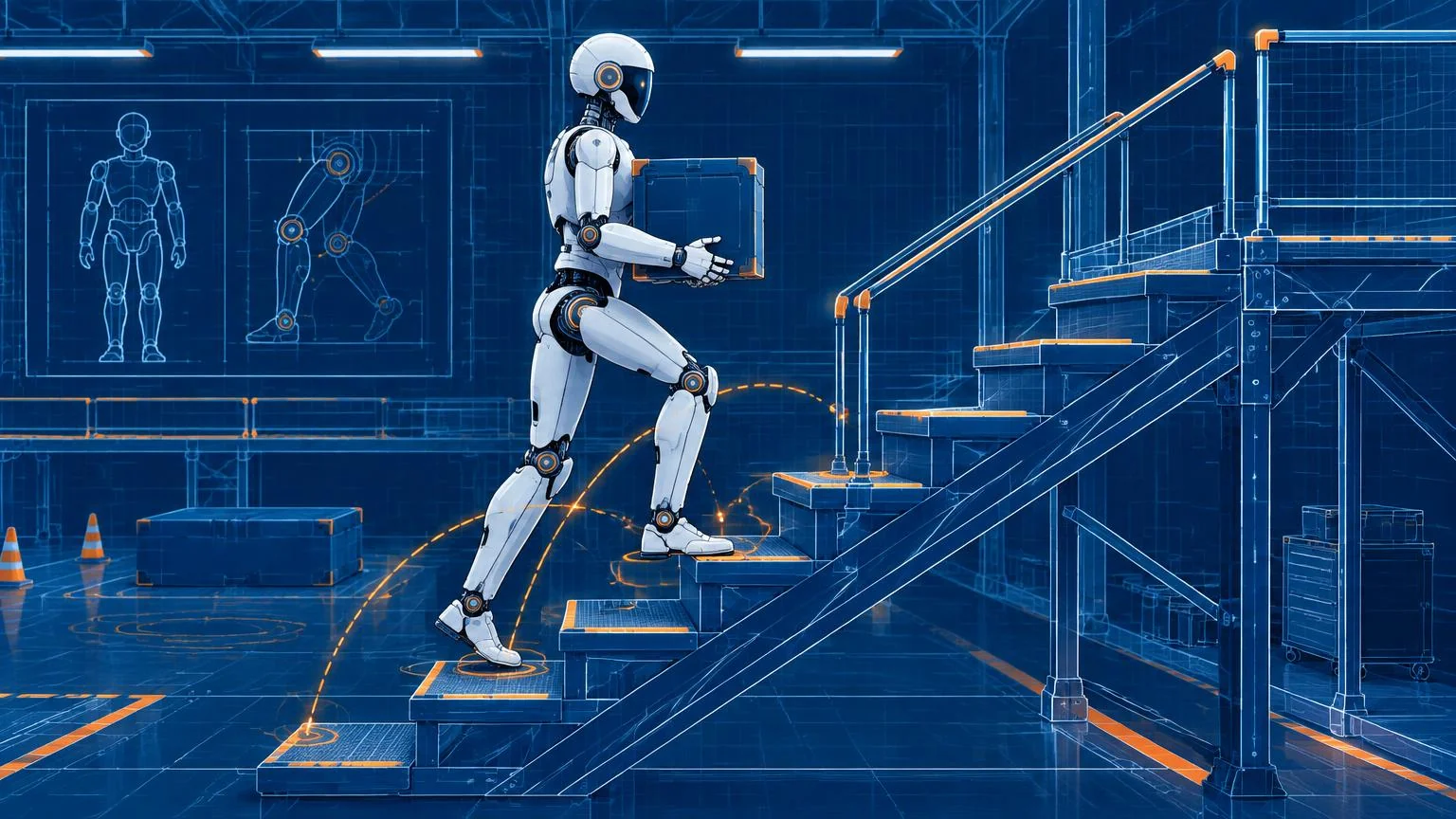
Robotics is where AI meets the physical world. Industrial robots have worked in car factories since the 1960s, but they followed fixed programmes in carefully controlled spaces. The new generation of physical AI uses the same learning techniques as language models to let robots see, plan and adapt.
Humanoid robots, designed to work in spaces built for people, are the most visible part of this trend. In 2026 Agility Robotics' Digit was working in logistics warehouses, Figure's robots had been tested in BMW car manufacturing, Tesla was developing its Optimus robot, and the Norwegian-American company 1X opened a factory to build its NEO home robot, first offered for pre-order in October 2025 at around $20,000, with deliveries to US homes planned during 2026. Chinese companies, including Unitree, ship the majority of humanoid units by volume.
These robots are still limited, often clumsy and expensive, and many home tasks remain beyond them. Training a robot is hard because physical data is scarce and mistakes are costly. That is why simulation is so important: robots can practise millions of times in a virtual world before trying in the real one. You can try this yourself in the drayz.ai Robotics Lab, where you tune the maths, weight and weather and watch a humanoid learn to walk.
Full chapter coming soon: Robotics and humanoid robots: AI in the physical world
How UK businesses can start using AI
Most of the value of AI for a typical UK business comes not from building models, but from applying existing AI tools to everyday work. A practical way to begin:
- Start with a problem, not the technology. List the jobs that eat up time: answering the same questions, chasing invoices, writing quotes, typing up notes, searching for documents, booking appointments. The best first AI projects are frequent, repetitive and easy to check.
- Try off-the-shelf tools first. A business subscription to a mainstream AI assistant, used well, can save hours a week per person. Many accounting, CRM and phone systems now include built-in AI features.
- Write an AI policy. Set simple rules: which tools are approved, what data must never be pasted in, when outputs must be checked, and who is accountable. The ICO publishes guidance on AI and data protection.
- Protect personal and confidential data. Use business plans that don't train on your data, check where data is stored, and carry out a data protection impact assessment for higher-risk uses.
- Keep a human in the loop. Let AI draft and prepare; let people check and decide, especially for anything legal, financial, medical or customer-facing.
- Measure the result. Track time saved, response times, errors and customer satisfaction, so you know what is working.
- Then integrate and automate. Once you know where AI helps, connect it to your systems: AI phone agents that answer and book calls, automations that move data between apps, or custom AI software built around your processes.
- Train your people. The biggest gains come from staff who understand what AI is good at and where it fails.
drayz.ai, based in Stoke-on-Trent, builds AI software, AI telephone and sales agents and AI integrations for UK businesses. If you would like to talk through where AI could help your organisation, get in touch.
Full chapter coming soon: A practical guide to AI for UK businesses
The future of AI
Nobody knows exactly where AI is heading, and past predictions have often been wrong in both directions. But several trends look likely to continue over the next few years:
- More capable agents. AI that can work independently for longer, use more tools and handle whole workflows, with people supervising rather than doing every step.
- Cheaper, smaller, faster models that run on phones, laptops and inside everyday devices, often without sending data to the cloud.
- AI in science. Faster discovery of drugs, materials and new scientific knowledge, building on breakthroughs such as AlphaFold.
- Physical AI. Robots, including humanoids, that learn general skills and slowly move from factories and warehouses into hospitals, shops and homes.
- Personal AI. Assistants that know your preferences, manage your calendar and inbox and act on your behalf, raising new questions about privacy and trust.
- Regulation and standards. More testing, auditing and legal rules, including the EU AI Act's high-risk regime from 2027-28 and, potentially, UK legislation for the most powerful models.
- Energy and infrastructure becoming a central constraint, and a central political question.
- The AGI debate. Whether, when and how AI might reach or surpass human-level ability across most tasks will remain one of the defining questions of our time.
What is certain is that AI is no longer a niche technology. Understanding it, its history, its strengths, its costs and its risks, is becoming part of basic literacy for businesses, workers and citizens.
Full chapter coming soon: The future of AI: what happens next?
Frequently asked questions
What is AI in simple terms?
AI is technology that lets computers do things that normally need human intelligence, such as understanding language, recognising images, making predictions and decisions. Most modern AI learns these skills from examples rather than following hand-written rules.
Who invented AI?
No single person. Alan Turing laid the foundations with his work on computation (1936) and machine intelligence (1950). The term "artificial intelligence" was coined by John McCarthy and colleagues in their 1955 proposal for the 1956 Dartmouth workshop, which is usually treated as the birth of AI as a field.
When did AI start?
AI as a research field started in 1956 at the Dartmouth workshop. The ideas behind it go back much further, to Ada Lovelace and Charles Babbage in the 1840s and to Alan Turing in the 1930s and 1950s. The first AI programs ran on British computers in Manchester in the early 1950s.
What is the difference between AI, machine learning and deep learning?
AI is the broad goal of making machines intelligent. Machine learning is the most successful approach to AI: systems that learn from data. Deep learning is a type of machine learning that uses neural networks with many layers, and it powers most of today's AI, including chatbots and image generators.
Is AI dangerous?
AI brings real risks, including bias, misinformation, deepfakes, privacy breaches, cyberattacks and job disruption, and some experts warn that future systems could be very hard to control. It also brings large benefits in health, science and productivity. Most experts agree the risks can be reduced with good design, testing, regulation and human oversight, but they disagree about how serious the long-term risks are.
Will AI take my job?
AI is more likely to change your job than to replace it entirely, at least in the near term. It tends to take over specific tasks, such as drafting, summarising and data entry. Entry-level roles appear to be under the most pressure. People who learn to use AI well are likely to be in a stronger position.
How much does AI cost for a small business?
Many AI tools are free to try, and business plans for mainstream AI assistants usually cost around £15 to £50 per user per month. Custom AI projects, such as AI phone agents or integrations with your own systems, cost more but can save significant staff time. The biggest hidden costs are data preparation, integration and training.
Is AI regulated in the UK?
There is no single UK AI Act. Existing laws on data protection, equality, consumer protection, online safety and product safety apply to AI, and regulators apply five principles in their sectors. The government has said it plans to legislate for the most powerful AI models, but no bill has yet been introduced. UK firms selling into the EU may also be covered by the EU AI Act.
What is generative AI?
Generative AI creates new content, such as text, images, audio, video or code, in response to a prompt. ChatGPT, Claude, Gemini and image generators are examples. It works by learning the patterns in huge amounts of existing content and producing new content that follows those patterns.
What is AGI?
Artificial general intelligence (AGI) means AI that could learn and perform most intellectual tasks as well as a human, across many different fields. It does not exist yet, there is no agreed definition, and experts disagree sharply about whether and when it might be built.
Sources and further reading
- Office for National Statistics: Artificial intelligence in UK businesses: 2023 to 2026, and Business insights and impact on the UK economy (2026 bulletins).
- International Energy Agency: Energy and AI (2025).
- Epoch AI: How much does it cost to train frontier AI models? and Trends in Artificial Intelligence.
- Stanford HAI: AI Index Report.
- International AI Safety Report 2026, chaired by Yoshua Bengio.
- Department for Science, Innovation and Technology: AI Opportunities Action Plan (2025) and AI Opportunities Action Plan: One Year On (2026).
- Department for Science, Innovation and Technology: A pro-innovation approach to AI regulation (white paper, 2023).
- European Union: Regulation (EU) 2024/1689 (the AI Act) and the 2026 Digital Omnibus on AI.
- A. M. Turing, "Computing Machinery and Intelligence", Mind, 1950.
- J. McCarthy, M. Minsky, N. Rochester and C. Shannon, A Proposal for the Dartmouth Summer Research Project on Artificial Intelligence, 1955.
- Sir James Lighthill, Artificial Intelligence: A General Survey (the Lighthill Report), 1973.
Chapters
Foundations
History
02
From ancient automata to Alan Turing
The prehistory of AI: myths, Babbage and Lovelace, Bletchley Park and the first British AI programs.
9 min read →
03
Dartmouth and the golden age of AI, 1956-1973
The founding of AI, the first programs, ELIZA, Shakey and the Lighthill Report.
10 min read →
04
AI winters and expert systems, 1974-1993
Two AI winters, the expert systems boom, Alvey and the return of neural networks.
9 min read →
05
The machine learning era, 1993-2011
Deep Blue, search engines, spam filters, driverless cars, ImageNet, Watson and Siri.
9 min read →
06
The deep learning revolution, 2012-2017
AlexNet, DeepMind, AlphaGo, GANs and the Transformer.
11 min read →
07
Transformers and large language models, 2018-2022
BERT, GPT-3, AlphaFold and the road to ChatGPT.
10 min read →
08
The generative AI boom, 2022-2024
ChatGPT, the AI race, Bletchley Park and the EU AI Act.
12 min read →
09
AI in 2025 and 2026: reasoning models and agents
Reasoning models, AI agents, open models, the infrastructure boom and where AI stands today.
10 min read →
How AI works
10
How neural networks work
Neurons, weights, training and backpropagation without the maths.
Coming soon
11
How large language models are trained
Data, compute, pre-training, fine-tuning and human feedback.
Coming soon
12
Computer vision, speech and multimodal AI
How AI sees, hears and speaks.
Coming soon
13
Robotics and humanoid robots
AI in the physical world.
Coming soon
Money and impact
14
The cost of AI
Chips, data centres, energy and what businesses really pay.
11 min read →
15
AI and the environment
Energy, water and climate.
Coming soon
16
A practical guide to AI for UK businesses
How to start, what it costs and what to avoid.
Coming soon
17
AI and jobs in the UK
What is really happening to work.
10 min read →
18
AI in healthcare and science
From AlphaFold to the NHS.
Coming soon
Risks and rules
19
The risks of AI
Bias, deepfakes, privacy, security and loss of control.
Coming soon
20
AI safety and alignment
How researchers try to keep AI under control.
Coming soon
21
AI law in the UK and EU
What businesses need to know.
14 min read →
22
The UK AI landscape
Companies, research, government and AI Growth Zones.
Coming soon
The future
23
The future of AI
What happens next?
Coming soon
24
AI glossary
Plain-English definitions of AI terms.
Coming soon