AI Guide · Updated 14 November 2026
History
Dartmouth and the golden age of AI, 1956-1973
By drayz.ai · Updated · 10 min read
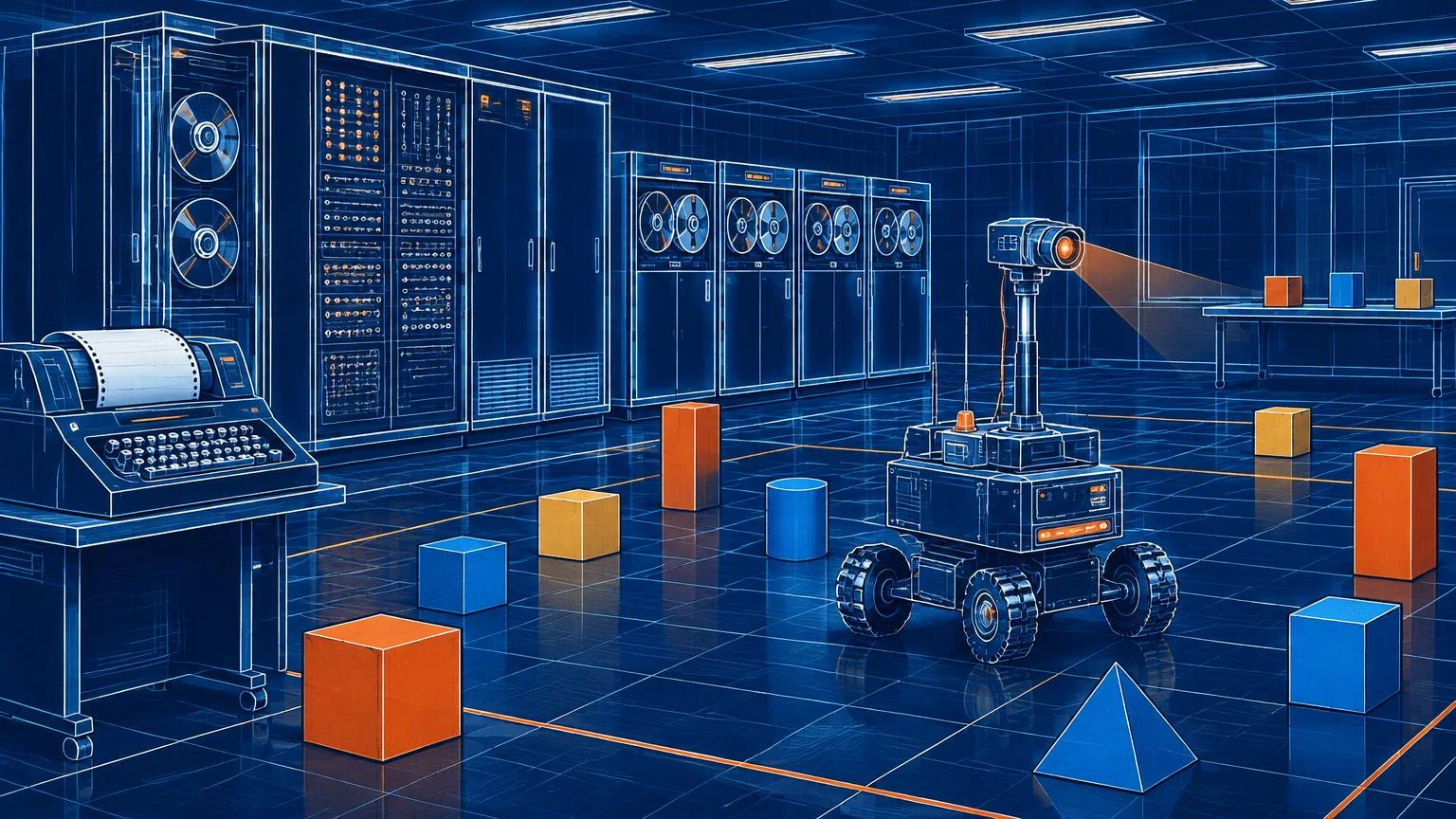
In the summer of 1956 a small group of scientists met at Dartmouth College in New Hampshire and gave a new field its name: artificial intelligence. The next seventeen years were AI's first golden age, full of brilliant ideas, landmark programs and wildly optimistic predictions. They ended with a bump, when governments on both sides of the Atlantic decided the promises had not been kept. This chapter covers 1956 to 1973.
The Dartmouth workshop, 1956
In 1955 John McCarthy, then a young mathematics professor at Dartmouth, persuaded Marvin Minsky (Harvard), Nathaniel Rochester (IBM) and Claude Shannon (Bell Labs) to co-sign a proposal to the Rockefeller Foundation for a "2 month, 10 man study of artificial intelligence". The proposal listed the problems they wanted to tackle, which read like a to-do list for the next seventy years of AI:
- automatic computers and how to program them;
- how a computer can be programmed to use a language;
- "neuron nets";
- measuring how complex a calculation is;
- self-improvement;
- abstractions;
- randomness and creativity.
The workshop ran over about eight weeks in the summer of 1956. It was less a structured conference than a loose gathering: people came and went, and the full group was rarely together. Attendees included Ray Solomonoff, Oliver Selfridge, Trenchard More, Arthur Samuel, and Allen Newell and Herbert Simon from Carnegie Tech (now Carnegie Mellon University). It produced no single breakthrough. What it did produce was a name, a community and a shared belief that intelligence could be mechanised. Many of the people there would lead AI research for the next two decades.
The Logic Theorist and the General Problem Solver
The most impressive work shown at Dartmouth came from Allen Newell, Herbert Simon and programmer Cliff Shaw. Their Logic Theorist, completed in 1956, proved 38 of the first 52 theorems in Chapter 2 of Russell and Whitehead's Principia Mathematica, and found a shorter, more elegant proof for one of them than the original. It is often called the first artificial intelligence program.
The Logic Theorist introduced ideas that are still central to AI:
- Search: treating problem-solving as a search through a tree of possibilities.
- Heuristics: rules of thumb that guide the search towards promising options, instead of trying everything.
- List processing: representing knowledge as linked structures of symbols.
Newell and Simon followed it with the General Problem Solver (GPS) around 1957-59, which aimed to solve any problem that could be expressed formally, using "means-ends analysis": compare where you are with where you want to be, and choose actions that reduce the difference. GPS could solve puzzles such as the Tower of Hanoi but struggled with real-world problems, where the number of possibilities explodes.
Newell and Simon also proposed the physical symbol system hypothesis: that a system which manipulates symbols has the necessary and sufficient means for general intelligent action. It became the philosophical foundation of symbolic AI.
LISP and the AI laboratories
In 1958 John McCarthy, by then at MIT, created LISP (LISt Processing), a programming language designed for symbolic AI. It introduced ideas such as recursion, dynamic memory management and treating programs as data. LISP became the language of AI research for thirty years, and it is still in use today.
AI research clustered around a few well-funded laboratories:
- MIT, where McCarthy and Minsky set up the AI Project in 1959, later the MIT AI Lab.
- Carnegie Mellon, with Newell and Simon.
- Stanford, where McCarthy moved in 1962 and founded the Stanford AI Laboratory (SAIL).
- SRI International (Stanford Research Institute).
- In the UK, Edinburgh, where Donald Michie, a former Bletchley Park codebreaker and friend of Turing, founded what became the Department of Machine Intelligence and Perception in the mid-1960s.
Much of the American work was funded by the US Advanced Research Projects Agency (ARPA, later DARPA), which during the 1960s gave AI researchers generous funding with few strings attached.
Machines that learn: the Perceptron and Samuel's checkers
Not all early AI was about logic. Some researchers wanted machines that learned from experience.
Arthur Samuel's checkers program
At IBM, Arthur Samuel developed a checkers (draughts) program from 1952 that improved by playing against itself and remembering which positions led to wins. In a 1959 paper he popularised the term machine learning. In 1962 his program beat a respected amateur player, Robert Nealey, a result IBM promoted heavily (although the claim that it had beaten a "champion" was an overstatement). Samuel's work is an ancestor of the self-play learning that would power AlphaGo more than fifty years later.
Frank Rosenblatt's Perceptron
In 1957-58 the psychologist Frank Rosenblatt at the Cornell Aeronautical Laboratory introduced the Perceptron, a simple artificial neural network that learned to classify inputs by adjusting the strengths of its connections. He built a hardware version, the Mark I Perceptron, with a 20-by-20 grid of light sensors wired to adjustable resistors turned by electric motors. It could learn to distinguish simple shapes.
The press went wild. A 1958 New York Times report suggested the US Navy expected the Perceptron eventually to walk, talk, see, write, reproduce itself and be conscious of its existence. Rosenblatt himself was more careful, but the hype set expectations the technology could not yet meet.
Other early learning systems included Oliver Selfridge's Pandemonium (1959), a model of pattern recognition built from competing "demons", and Bernard Widrow and Ted Hoff's ADALINE (1960), an adaptive neuron used in echo cancellation on telephone lines.
Teaching computers language
ELIZA
In 1964-66 Joseph Weizenbaum at MIT wrote ELIZA, a program that held typed conversations. Its most famous script, DOCTOR, imitated a Rogerian psychotherapist by reflecting users' statements back as questions ("I am unhappy" might become "Why do you say you are unhappy?"). ELIZA had no understanding at all; it matched keywords and rearranged sentences.
Yet people formed emotional attachments to it. Weizenbaum was disturbed to find that his own secretary asked him to leave the room so she could talk to ELIZA privately. The tendency to attribute understanding and feelings to a computer that merely produces plausible text is now called the ELIZA effect, and it is more relevant than ever in the age of chatbots. Weizenbaum became one of the first critics of AI, arguing in his 1976 book Computer Power and Human Reason that some decisions should never be handed to machines.
SHRDLU
Between 1968 and 1970 Terry Winograd at MIT built SHRDLU, which understood typed English commands about a simulated "blocks world" of coloured blocks, pyramids and boxes. You could tell it "Find a block which is taller than the one you are holding and put it into the box", ask why it had done something, or teach it new words. SHRDLU was a dazzling demonstration, but it only worked because its world was tiny and perfectly defined. Scaling it to the real world proved impossible with the methods of the time.
Machine translation
Machine translation was one of the earliest goals of AI, driven by Cold War interest in reading Russian scientific papers. The Georgetown-IBM experiment of 1954 translated more than 60 Russian sentences into English and generated optimistic headlines. But progress was slow, and in 1966 the US government's ALPAC report concluded that machine translation was slower, less accurate and more expensive than human translation, and recommended cutting funding. It was an early warning of what was to come for AI as a whole.
Robots that reason: Shakey
From 1966 to 1972 the Stanford Research Institute built Shakey, the first mobile robot that could reason about its own actions. Shakey was a wheeled cart carrying a TV camera, a range finder and bump sensors, connected by radio to a large computer. Given a command such as "push the block off the platform", it could perceive its surroundings, plan a sequence of actions and carry them out, although each step took a long time.
The Shakey project produced ideas still used today:
- the A* search algorithm (1968), used in route planning, video games and robotics, including the robot in the drayz.ai Robotics Lab;
- the STRIPS planning system;
- the modern form of the Hough transform, still used for detecting lines and shapes in images.
Expert knowledge: DENDRAL
At Stanford, Edward Feigenbaum, Nobel laureate Joshua Lederberg and Bruce Buchanan began DENDRAL in 1965. It helped chemists work out the molecular structure of unknown compounds from mass spectrometry data, by encoding the knowledge of expert chemists as rules. DENDRAL showed that AI could reach expert-level performance in a narrow field if it had enough specialised knowledge. It led directly to the expert systems boom of the 1980s.
Optimism and predictions
The early successes made researchers confident, sometimes extremely so:
- In 1958 Newell and Simon predicted that within ten years a computer would be world chess champion and would discover and prove an important new mathematical theorem.
- In 1965 Herbert Simon predicted that within twenty years machines would be capable of doing any work a person can do.
- In 1967 Marvin Minsky predicted that within a generation the problem of creating artificial intelligence would be substantially solved.
- In 1970 Minsky reportedly told Life magazine that in three to eight years we would have a machine with the general intelligence of an average human being.
None of these came true on schedule. A computer did not beat the world chess champion until 1997, almost forty years later. General human-level AI has still not been achieved.
The problems they ran into
By the early 1970s it was becoming clear that early AI faced deep difficulties:
- Combinatorial explosion. Search worked on toy problems, but the number of possibilities grows exponentially with problem size. Real problems overwhelmed the computers of the day.
- Limited computing power. Computers had a tiny fraction of the memory and speed of a modern phone. Ross Quillian's work on language had to run with a vocabulary of about twenty words because that was all that fitted in memory.
- Common-sense knowledge. Understanding even a children's story requires vast amounts of everyday knowledge that nobody had written down.
- The frame problem. Logic-based systems struggled to represent what does not change when an action is taken.
- Moravec's paradox. Things that are hard for people (algebra, chess) turned out to be relatively easy for computers, while things that are easy for people (recognising faces, walking across a room) turned out to be extraordinarily hard.
Perceptrons and the neural network chill
In 1969 Marvin Minsky and Seymour Papert published Perceptrons, a rigorous mathematical analysis showing that single-layer perceptrons could not learn certain simple functions, such as "exclusive or" (XOR). They were sceptical that multi-layer networks would overcome the problem. Although the book's conclusions applied mainly to single-layer networks, it was widely read as a verdict against neural networks in general. Funding and interest shifted heavily towards symbolic AI, and neural network research went into a long decline. Rosenblatt died in a boating accident in 1971, aged 43, and did not live to see the revival of his ideas.
The Lighthill Report, 1973
In 1972 the UK Science Research Council asked the applied mathematician Sir James Lighthill to review AI research in Britain. His report, Artificial Intelligence: A General Survey, published in 1973, was scathing. He divided AI into three categories: advanced automation (useful), computer-based studies of the central nervous system (useful) and the "bridge" between them, building robots and general intelligent systems, which he judged to have failed. He argued that AI had failed to achieve its "grandiose objectives" and that its methods would not scale beyond toy problems because of combinatorial explosion.
The report was debated live on BBC television in 1973, with Lighthill facing Donald Michie, John McCarthy and Richard Gregory. Its effect was severe. The British government cut support for AI research at most universities, leaving Edinburgh and a few others to continue on a much smaller scale. In the United States, DARPA was also becoming impatient, especially after a disappointing speech-understanding research programme, and under the 1969 Mansfield Amendment it was required to fund mission-oriented research with direct military uses. Funding for undirected AI research fell sharply.
The first AI winter had begun.
What the golden age left behind
Despite the disappointment, the period from 1956 to 1973 created much of the vocabulary and toolkit of AI:
- the name "artificial intelligence" and the idea of AI as a field;
- heuristic search, planning and the A* algorithm;
- LISP and symbolic programming;
- the first learning machines, including the Perceptron and self-improving game players;
- the first chatbots and natural-language systems, and the ELIZA effect;
- the first knowledge-based expert system, DENDRAL;
- the first intelligent mobile robot, Shakey;
- and a hard lesson about overpromising that the field has had to relearn more than once.
Key takeaways
- The 1956 Dartmouth workshop named the field and brought together its founders.
- The Logic Theorist, GPS, LISP, ELIZA, SHRDLU, Shakey and DENDRAL all came from this era.
- Learning machines such as Samuel's checkers program and Rosenblatt's Perceptron were early forms of machine learning.
- Extravagant predictions, combinatorial explosion and weak computers led to disappointment.
- The UK's Lighthill Report (1973) and US funding cuts triggered the first AI winter.
Previous chapter: From ancient automata to Alan Turing · Next chapter: AI winters and the rise and fall of expert systems