AI Guide · Updated 14 November 2026
Foundations
What is artificial intelligence?
By drayz.ai · Updated · 8 min read
Artificial intelligence is the science and engineering of making machines do things that would require intelligence if people did them. That includes understanding and producing language, recognising what is in an image, learning from experience, solving problems, planning and making decisions. This chapter explains what the term really means, the different kinds of AI, and how to recognise AI in everyday life.
Where the term came from
The phrase "artificial intelligence" was coined by the American computer scientist John McCarthy. In August 1955 he, Marvin Minsky, Nathaniel Rochester and Claude Shannon wrote a proposal for a two-month summer research project at Dartmouth College in New Hampshire, to be held in 1956. They needed a name for a new field that would study how to make machines use language, form concepts, solve problems "now reserved for humans" and improve themselves. McCarthy chose "artificial intelligence", partly to distinguish the new field from cybernetics, which was then fashionable.
The name stuck, although many researchers have since complained about it. "Artificial" can sound fake, and "intelligence" has never had a precise definition, even for people.
Definitions you will come across
There is no single official definition of AI. Here are some of the most useful ones:
- The textbook definition. Stuart Russell and Peter Norvig's Artificial Intelligence: A Modern Approach, the most widely used university textbook, describes AI as the study of agents that perceive their environment and take actions to achieve their goals as well as possible.
- The OECD definition, adopted in modified form by the EU AI Act, describes an AI system as a machine-based system that, for explicit or implicit objectives, infers from the input it receives how to generate outputs such as predictions, content, recommendations or decisions that can influence physical or virtual environments, with varying levels of autonomy and adaptiveness.
- The UK government's approach deliberately avoids a single legal definition. Its 2023 white paper instead defined AI by two characteristics that create regulatory challenges: adaptivity (it learns and can behave in ways its designers did not explicitly program) and autonomy (it can make decisions without a human controlling every step).
- The practical definition. In business today, "AI" usually means software that learns from data, especially machine learning and generative AI.
A useful rule of thumb: if a system's behaviour was learned from data or it can generate, predict or decide in ways its programmers did not spell out line by line, it is probably what people mean by AI.
AI, machine learning, deep learning and generative AI
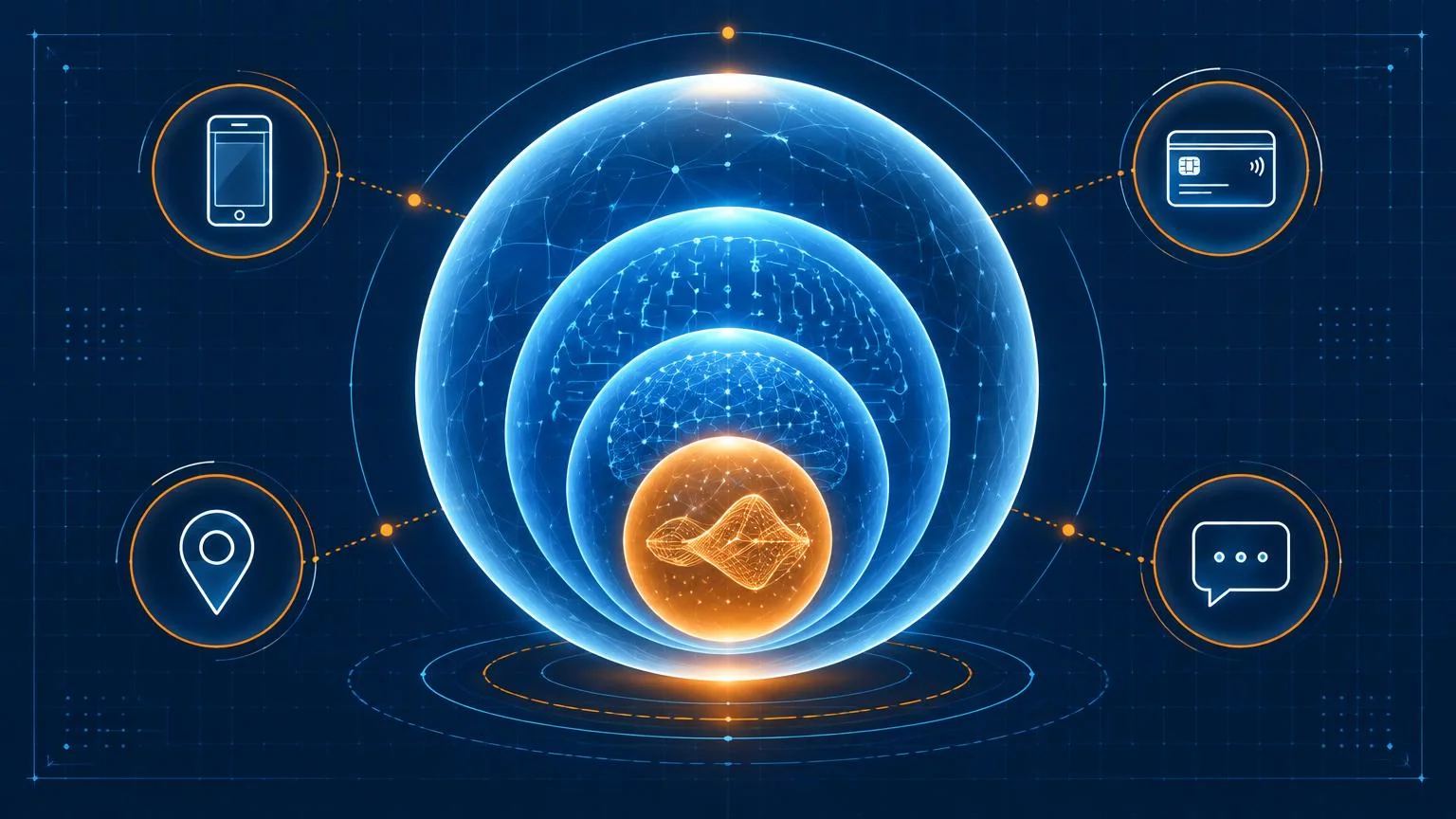
These terms are often used interchangeably, but they nest inside each other like Russian dolls.
| Term | What it means | Example |
|---|---|---|
| Artificial intelligence | The whole field of making machines intelligent, by any method | A chess program, a route planner, a chatbot |
| Machine learning | AI systems that learn patterns from data rather than following hand-written rules | A spam filter that learns from emails you mark as junk |
| Deep learning | Machine learning using neural networks with many layers | Face recognition on your phone |
| Generative AI | Deep learning models that create new content | ChatGPT writing a letter; an image generator making a picture |
| Large language model (LLM) | A generative model trained on huge amounts of text to predict the next token | GPT, Claude, Gemini, Llama, Mistral, Qwen |
| AI agent | A system that uses a model to plan and take actions with tools | An assistant that researches suppliers and fills in an order form |
Not all AI is machine learning. Route-planning in a sat-nav uses search algorithms; a tax calculator uses rules; a chess engine combines search with learned evaluation. But almost all of the AI that has transformed the world since 2012 is machine learning, and most of that is deep learning.
The main kinds of AI
By capability: narrow, general and super
Narrow AI is designed for a specific task or set of tasks. A model that predicts which customers might cancel their subscription is narrow AI. So is a system that reads chest X-rays. Every AI system in commercial use today is narrow in this sense, although large language models blur the line because they can do so many different things: write poetry, explain tax rules, translate Welsh and write Python code.
Artificial general intelligence (AGI) is the idea of AI that matches human ability across most intellectual tasks, including learning new tasks quickly. Some leaders of AI companies say AGI could arrive this decade. Many academics doubt it, or question whether "AGI" is even a coherent goal. There is no agreed test that would settle the matter.
Artificial superintelligence (ASI) would far exceed the best human minds in almost every field, including science, strategy and social skills. It is speculative, but because the consequences could be enormous, it is a focus of AI safety research.
By approach: symbolic, statistical and hybrid
Symbolic AI represents knowledge explicitly, as facts and rules, and reasons with logic. It dominated AI from the 1950s to the 1980s and produced expert systems used in medicine, engineering and finance. It is transparent: you can see exactly which rule led to a conclusion. But it struggles with the messiness of the real world, and someone has to write and maintain all the rules.
Statistical or connectionist AI learns from data. Neural networks are the best-known example. They handle noisy, ambiguous information such as images, speech and everyday language extremely well, but their internal workings are hard to interpret.
Hybrid AI combines both. Many modern systems use a neural network for perception and language, then call on rule-based tools, databases, calculators or code for precise reasoning.
By function: what the system does
- Perception: seeing (computer vision), hearing (speech recognition), reading (optical character recognition).
- Language: understanding and generating text and speech, translation, summarisation.
- Prediction: forecasting demand, prices, risk or behaviour.
- Recommendation: suggesting products, films, songs, news or friends.
- Generation: creating text, images, audio, video, 3D models and code.
- Planning and control: scheduling, routing, playing games, controlling robots and vehicles.
- Action (agents): combining the above to carry out tasks in software or the physical world.
By how it learns
- Supervised learning: learns from labelled examples. Show it thousands of photos labelled "dog" or "cat" and it learns to tell them apart.
- Unsupervised learning: finds patterns without labels, such as grouping similar customers or spotting unusual transactions.
- Self-supervised learning: creates its own labels from raw data, for example predicting the next word in a sentence. This is how language models learn most of what they know.
- Reinforcement learning: learns by trial and error, rewarded for good outcomes. Used for game-playing AI, robotics, and fine-tuning chatbots with human feedback.
Everyday examples of AI in the UK
You probably use AI dozens of times a day without noticing:
- Phones: face unlock, predictive text, voice assistants, photo search ("show me pictures of the beach"), call screening.
- Banking: fraud alerts when your card is used somewhere unusual; credit decisions; chatbots in banking apps.
- Shopping: recommendations on Amazon or Tesco, dynamic pricing, fraud checks at checkout, delivery route planning.
- Entertainment: what Netflix, Spotify, YouTube and TikTok show you next.
- Travel: Google Maps and Waze traffic predictions; airline pricing; automatic number-plate recognition at car parks.
- Health: NHS services use AI to help read scans, prioritise patients and transcribe consultations, always with clinicians in charge.
- Work: email spam filtering, meeting transcription, document summaries, AI writing assistants, coding assistants.
- Customer service: chatbots and, increasingly, AI voice agents that answer phone calls and book appointments.
What AI is not
Some common misunderstandings are worth clearing up.
AI is not conscious. Today's AI systems do not have feelings, desires or experiences in any way we can establish. A chatbot that says "I feel happy to help" is producing words that fit the conversation, not reporting an inner state. Whether a future AI could be conscious is an open philosophical question, and some researchers take it seriously, but there is no scientific consensus.
AI is not a database of facts. A language model stores patterns, not a neat list of true statements. That is why it can make things up. Connecting it to search or trusted documents helps a lot.
AI is not magic, and it is not one product. It is a set of techniques that are very good at some things and poor at others. A model that writes a brilliant essay may still miscount the letters in a word.
AI does not "think like a human". Neural networks were loosely inspired by the brain, but they work very differently. AI can be superhuman at narrow tasks and surprisingly bad at things a child finds easy.
AI is not neutral. It reflects the data it was trained on and the choices of the people who built it, including their blind spots.
Measuring intelligence: from the Turing test to benchmarks
How would we know if a machine is intelligent? Alan Turing suggested his "imitation game" in 1950: a judge chats by text with a person and a machine, and if the judge cannot reliably tell which is which, the machine should count as thinking. Modern chatbots can now pass short, informal versions of the test, which has made it clear that fooling people in conversation is not the same as general intelligence.
Researchers now use benchmarks: standard tests of specific abilities, such as maths competition problems, graduate-level science questions, coding tasks, reading comprehension or the ability to complete real software engineering tasks. Benchmarks are useful but limited. Models can be trained (deliberately or accidentally) to score well without matching gains in real work, and once a benchmark is "solved", a harder one is needed. Increasingly, evaluators also measure how long and complex a task an AI agent can complete on its own, and whether it has dangerous capabilities.
Why the definition matters
Definitions are not just academic. They decide which systems fall under laws such as the EU AI Act, which products count as "AI" in marketing (some companies overuse the label, a practice nicknamed "AI washing"), and how businesses assess risk. If you are buying an "AI-powered" product, it is worth asking simple questions: What exactly does the AI do? What data was it trained on? How accurate is it, and how was that measured? What happens when it is wrong, and who checks?
Key takeaways
- AI is the effort to make machines do things that need intelligence when people do them.
- The term was coined in 1955 for the 1956 Dartmouth workshop.
- Machine learning, deep learning and generative AI are nested subsets of AI.
- All AI in use today is "narrow", although modern language models are remarkably broad.
- AI learns patterns, not truths, so it can be confidently wrong.
- In the UK, AI is regulated through existing laws and sector regulators rather than a single AI Act.
Next chapter: From ancient automata to Alan Turing: the prehistory of AI