AI Guide · Updated 14 November 2026
Money and impact
AI and jobs in the UK
By drayz.ai · Updated · 10 min read
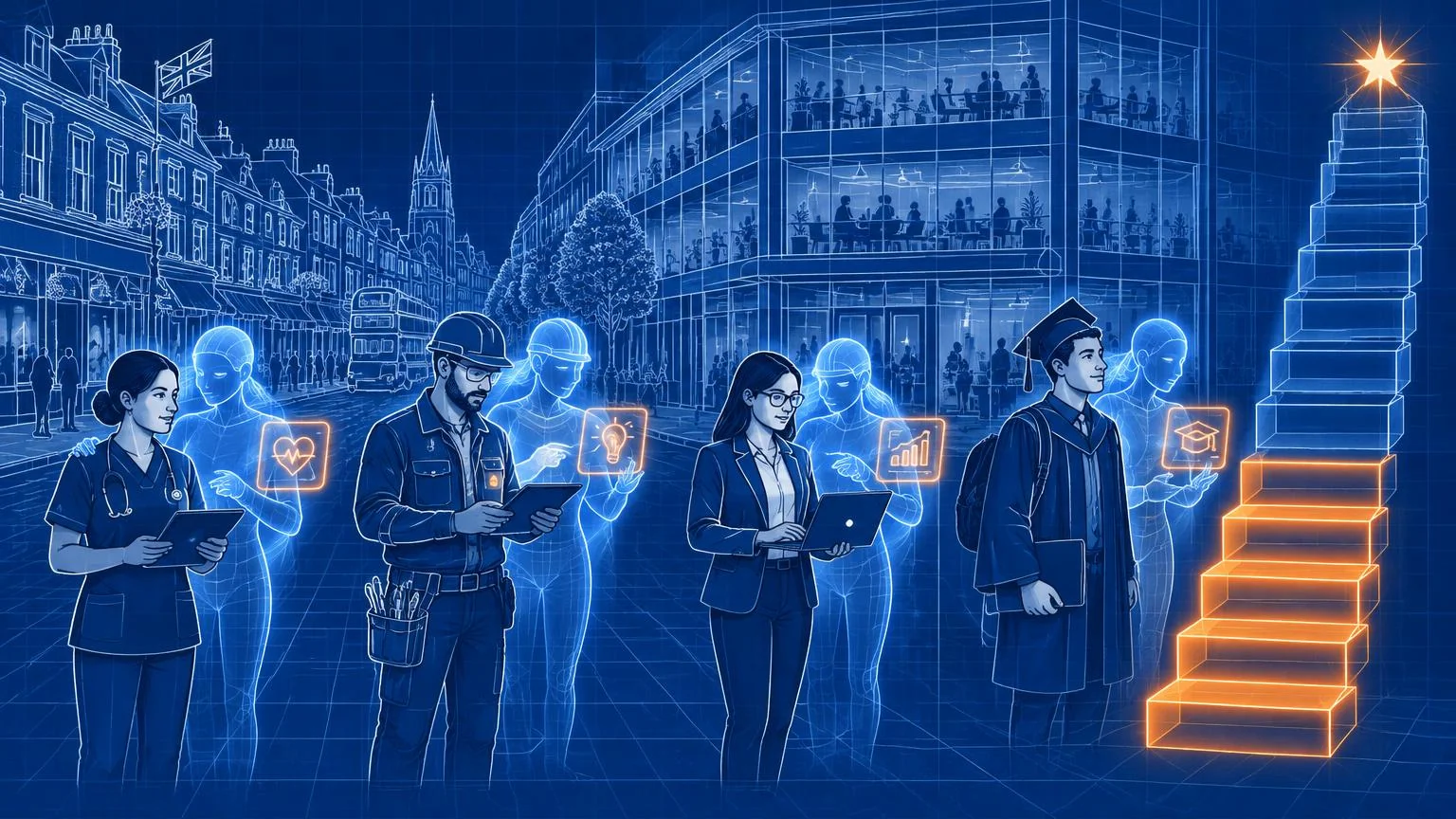
Is AI taking British jobs? In late 2026 the honest answer is: it is starting to change who gets hired, but it is not yet causing mass unemployment. The clearest effects so far are fewer vacancies in the occupations AI can do most of, a squeeze on entry-level and graduate roles, and a growing pay premium for people with AI skills. At the same time the UK jobs market has been weak for other reasons, including the economic cycle, higher employment costs and the unwinding of post-pandemic over-hiring, which makes it hard to separate AI from everything else. This chapter sets out what the evidence actually shows, which jobs are most exposed, what history suggests, and what workers and employers can do.
The big picture in 2026
Several things are happening at once in the UK labour market:
- Unemployment rose to around 5% in late 2025 and early 2026, its highest level since 2021, before easing slightly later in the year.
- Young people have been hit hardest. Unemployment among 16-24-year-olds rose to around 15-16% in 2026, and official figures showed roughly a million young people not in education, employment or training.
- Vacancies fell sharply from their 2022 peak, with the steepest falls in office-based occupations where AI is most capable.
- Demand for AI skills surged, with job adverts requiring AI skills and the wage premium for those skills both rising strongly in 2025.
Most economists believe AI is one cause among several. The weak economy, increases in employer National Insurance contributions and the minimum wage in April 2025, and companies correcting for over-hiring after the pandemic have all reduced hiring, especially in hospitality and retail, which are not very exposed to AI. But the pattern of which office jobs are disappearing fits what AI can now do.
What the evidence shows
Fewer adverts where AI is strongest
In August 2026 a Bank of England staff analysis of online job adverts grouped occupations by how exposed they are to AI. Over the previous three years, adverts fell by 15% in the most exposed third of occupations, 10% in the middle third and 6% in the least exposed. Customer service adverts fell by 23% and administrative adverts by 22%. The author cautioned that "confident attribution remains premature", because the post-pandemic cycle, labour costs and remote working changed at the same time.
A UK government assessment of AI and the labour market estimated that about two-thirds of UK workers are in occupations highly exposed to AI: roughly 35% in jobs where AI is more likely to complement people, and 32% in jobs where it is more likely to substitute for them, with the remaining third less exposed. That is a higher share than in the US, because the UK economy relies heavily on professional, financial and office-based services.
The squeeze on entry-level jobs
The strongest signal is at the bottom rung of the career ladder:
- A survey of 1,001 UK businesses for Lancaster University's Work Foundation, carried out in May 2026, found that 36% had reduced entry-level roles over the past year. Among larger firms, around six in ten of those that cut entry-level jobs said AI or automation was a reason.
- Job site Adzuna reported graduate and entry-level adverts falling to their lowest levels in about a decade.
- Research from King's College London, cited by Skills England, found that firms more exposed to AI reduced junior positions by around 6% compared with less exposed firms, while senior roles held up better.
- Several large professional services firms cut graduate intakes in 2024-2025.
But the picture is not one-sided. The Institute of Student Employers found that graduate hiring among its members rose by around 4% in 2026 after a fall in 2025, and its chief executive argued that economic uncertainty, not AI, was the main reason employers had cut intakes. Many employers say they expect AI to change entry-level jobs rather than remove them.
The worry economists describe is that the traditional workforce "pyramid", with many juniors at the bottom, could become a "diamond": fewer juniors, because AI does much of the routine work that once trained them, and more experienced staff supervising AI. If that happens, the question becomes how people gain the experience to become senior in the first place.
Rising pay for AI skills
PwC's 2026 AI Jobs Barometer, based on more than a billion job adverts across 27 countries, found that:
- UK job adverts for roles requiring AI skills rose by about 61% in 2025, to around 180,000, back to 2022 levels.
- The UK wage premium for jobs requiring AI skills jumped to 34% in 2025, up from 11% the year before (globally the premium was around 62%).
- Only about 2% of UK job adverts formally required AI skills, suggesting demand still outstrips supply.
- Companies most exposed to AI showed faster productivity growth, and in many cases faster hiring, than less exposed companies.
Which jobs are most and least exposed?
"Exposure" means that AI can perform many of a job's tasks. It does not automatically mean the job will disappear: often AI takes over some tasks and the person does more of the rest.
Highly exposed occupations (lots of tasks AI can do):
- Administrative and secretarial work: scheduling, correspondence, data entry, record-keeping.
- Customer service and call centres, especially text and phone enquiries.
- Bookkeeping, payroll and parts of accounting.
- Paralegal work, document review and contract drafting.
- Translation, transcription, copywriting and some content production.
- Software development, especially routine coding and testing.
- Market research, data analysis and report writing.
- Graphic design for routine marketing material.
Less exposed occupations (physical, face-to-face or unpredictable work):
- Skilled trades: electricians, plumbers, builders, mechanics.
- Health and social care: nurses, care workers, paramedics, physiotherapists.
- Hospitality, cleaning and many retail roles.
- Emergency services, teaching young children, and jobs needing physical presence and judgement.
Exposure is not the same as risk. Highly paid professionals are often highly exposed, but they may benefit most if AI makes them more productive. Lower-paid administrative workers are exposed and may have fewer options to move into higher-value work, which is why many economists see AI as a risk to inequality as well as jobs.
Humanoid and warehouse robots could eventually affect physical jobs too, but in 2026 they remain expensive and limited, and widespread use in UK workplaces is likely to take many years.
How AI changes work rather than replacing it
For most people, the near-term effect of AI is on tasks within jobs:
- Lawyers use AI to draft and summarise, then check and advise.
- Doctors and nurses use "ambient voice" tools to write up notes, freeing time for patients.
- Teachers use AI to plan lessons and mark routine work.
- Software developers supervise AI coding agents that write, test and fix code.
- Small business owners use AI to write marketing, answer emails and handle phone calls.
Studies of real workplaces, such as customer support and consulting, have often found the biggest productivity gains for less experienced workers, because AI helps them perform closer to the level of experts. That is good for those workers, but it can also mean employers need fewer people overall, or fewer trainees.
New jobs are also appearing: AI engineers, data specialists, AI trainers and evaluators, people who design and supervise AI agents, AI governance and compliance roles, and many jobs in data centre construction and energy. Some UK employers have started creating graduate roles built around running AI agents.
What history tells us
Fears that machines will cause mass unemployment are old:
- In the early 1800s, the Luddites, textile workers in the English Midlands and North, smashed machines they blamed for destroying their livelihoods.
- In the 1930s, economist John Maynard Keynes warned of "technological unemployment".
- In the 1960s and again in the 1980s, automation and computers prompted similar fears.
Each time, technology destroyed many specific jobs but the overall number of jobs grew, as rising productivity created new demand and new occupations. Today most people work in jobs that did not exist in 1900.
However, history also shows that transitions can be painful. Some workers and regions never recovered from the decline of industries such as textiles, coal and steel, including in places like Stoke-on-Trent, whose pottery industry shrank dramatically in the late 20th century. The key question with AI is not only how many jobs exist in the long run, but how fast the change happens and who bears the cost. AI may spread faster than past technologies because it is delivered as software, and it affects office jobs that were previously seen as safe.
Forecasts: how big could the impact be?
Forecasts vary widely because nobody knows how fast AI will improve or be adopted:
- In 2024 the Institute for Public Policy Research estimated that, in a worst-case scenario with no government action, up to 8 million UK jobs could be lost to generative AI over time, while a better-managed scenario would see no job losses and significant economic gains.
- The International Monetary Fund estimated in 2024 that around 60% of jobs in advanced economies are exposed to AI, about half of which could benefit while the rest could see lower demand.
- Many economists expect AI to raise productivity, which the UK badly needs after more than a decade of slow growth, but disagree on how quickly and how evenly gains will be shared.
The honest conclusion is that significant disruption to specific occupations is likely over the next decade, while the overall effect on employment depends heavily on economic policy, education and how businesses choose to use AI.
What workers can do
Practical steps for anyone worried about AI and their job:
- Learn to use AI tools well in your current role. People who use AI effectively are more productive and, according to PwC's data, increasingly better paid.
- Focus on what AI does badly: judgement, responsibility, relationships, persuasion, care, physical skills, and understanding a specific business or community.
- Become the person who checks and directs AI. Knowing when AI is wrong is a valuable skill.
- Keep learning. Short courses, apprenticeships and free government and industry AI skills programmes can help.
- Consider less exposed careers, such as skilled trades, health and care, and energy, many of which face shortages.
- For young people: work experience, apprenticeships and building a portfolio of real work matter more than ever, because AI-assisted applications have made CVs harder to tell apart.
What employers can do
For UK businesses, a responsible approach to AI and jobs includes:
- Using AI to remove drudgery and grow the business, not only to cut headcount.
- Keeping a pipeline of junior staff, redesigned around AI, so the business still develops future experienced staff.
- Training existing staff before replacing roles.
- Being transparent with staff about how AI will be used.
- Following equality and data protection law when using AI in recruitment and management (see the chapter on AI law in the UK and EU).
What government is doing
The UK government has launched AI skills programmes, including commitments to train millions of workers in AI skills by 2030 in partnership with technology companies, and created Skills England to align training with employer needs. It has also published research on AI's impact on the labour market. Critics argue that much more is needed, particularly for young people, for workers in the most exposed administrative jobs, and to make sure productivity gains translate into higher wages.
Frequently asked questions
Is AI causing unemployment in the UK?
Not on a large scale yet, but it appears to be contributing to fewer vacancies in AI-exposed office jobs and fewer entry-level roles. UK unemployment rose to around 5% in 2025-2026 mainly because of a weak economy and higher employment costs, but Bank of England analysis found job adverts fell most in the occupations most exposed to AI.
Which UK jobs are most at risk from AI?
Jobs made up of routine information tasks are most exposed: administration, customer service, bookkeeping, paralegal work, translation, copywriting and some coding. Jobs requiring physical presence, care or complex judgement, such as trades, nursing and social care, are least exposed.
Is AI taking graduate jobs?
It is one factor. Surveys in 2026 found around a third of UK employers had cut entry-level roles, and larger firms often cited AI. But the Institute of Student Employers found graduate hiring rose by around 4% in 2026 and said economic uncertainty mattered more than AI so far.
Do AI skills lead to higher pay?
PwC's 2026 AI Jobs Barometer found UK job adverts requiring AI skills offered a wage premium of about 34% in 2025, up from 11% the year before.
Will AI create new jobs?
Yes. New roles are emerging in AI engineering, data, AI supervision and evaluation, governance and compliance, and in building data centres and energy infrastructure. Historically, new technologies have created more jobs than they destroyed over the long run, although transitions were painful for many workers.
Key takeaways
- AI is beginning to reshape UK hiring, most visibly in administrative, customer service and other routine office work.
- Bank of England staff found job adverts fell 15% in the most AI-exposed occupations versus 6% in the least exposed, but other economic factors are also at play.
- Entry-level roles are under the most pressure, raising concerns about how young people will gain experience.
- Demand and pay for AI skills rose sharply in 2025, with a UK wage premium of about 34%.
- Around two-thirds of UK workers are in jobs highly exposed to AI, but exposure often means changed tasks rather than lost jobs.
- History suggests technology creates more jobs than it destroys in the long run, but the transition can be hard for particular workers and places.
Previous chapter: The cost of AI · Next chapter: AI law in the UK and EU · Back to the complete guide to artificial intelligence