AI Guide · Updated 14 November 2026
Money and impact
The cost of AI
By drayz.ai · Updated · 11 min read
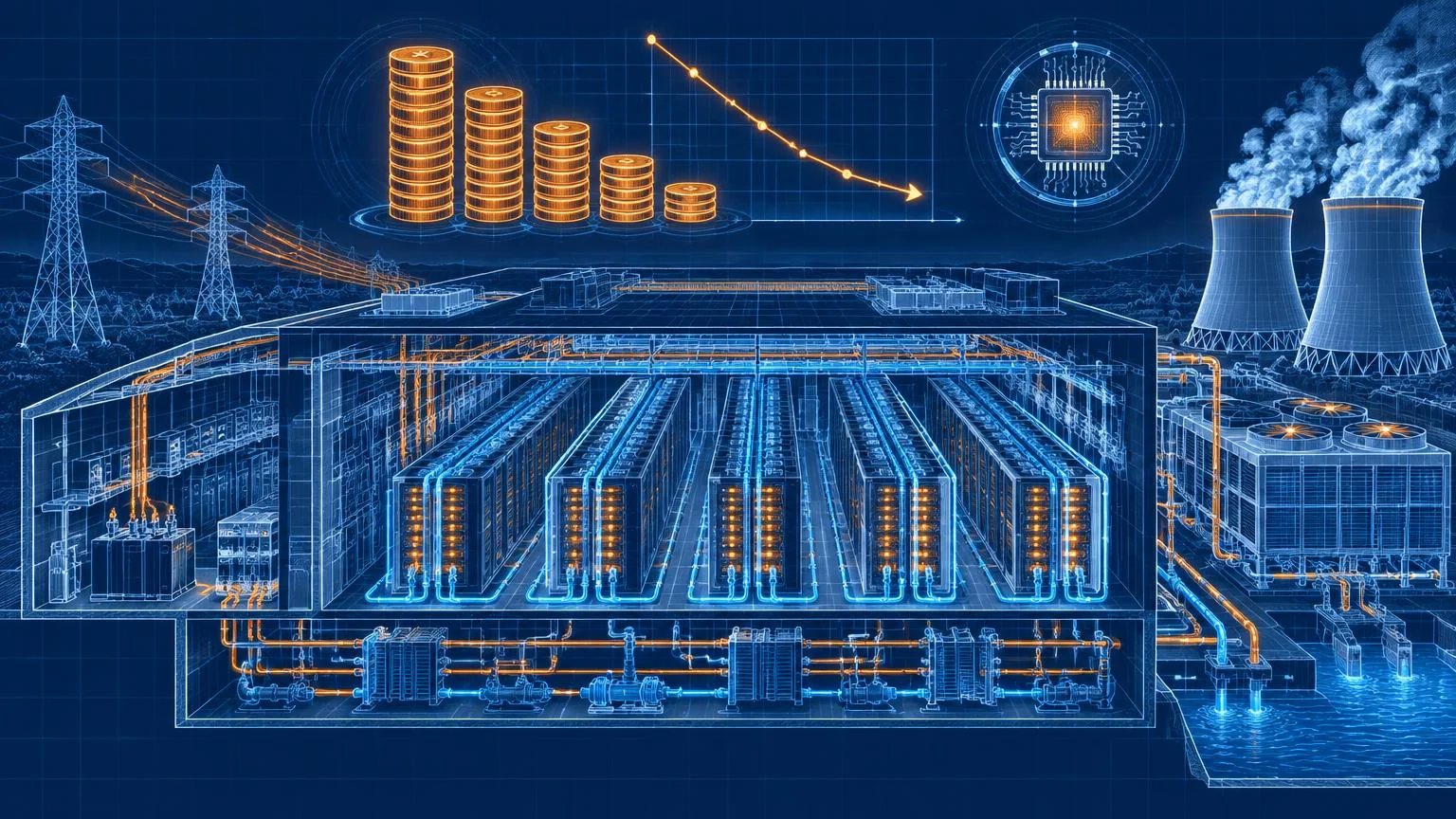
Artificial intelligence is both the most expensive technology ever built and one of the fastest-falling in price. Training a leading AI model now costs hundreds of millions of dollars, and the world's biggest technology companies are spending more on data centres in 2026 than many countries produce in a year. Yet the price of using AI at any given level of quality has been falling faster than almost any product in history. This chapter explains where the money goes, who pays it, why costs are rising and falling at the same time, and what AI really costs a UK business or household in late 2026.
Two different costs: building AI and using it
When people talk about "the cost of AI" they usually mean one of two very different things:
- Building AI (training). A company gathers huge amounts of data and runs it through thousands of specialised chips for weeks or months to produce a model. This is a large, one-off cost per model, paid by a handful of AI labs.
- Using AI (inference). Every time someone asks a chatbot a question, generates an image or runs an AI agent, the model has to do fresh calculations on chips in a data centre. Each request is cheap, but billions of requests a day add up, and this cost never stops while the model is in use.
For most of AI's history, training was the headline cost. Since the arrival of ChatGPT and, later, AI agents that work for minutes or hours at a time, inference has become the bigger share of spending. Industry analysts now estimate that the running costs of a popular frontier model can overtake its training cost within its first year in service.
There is also a third cost that is easy to forget: adopting AI. For a business, the subscription fee is often the smallest part of the bill. Staff time, training, changing processes, integrating with existing systems, checking outputs and managing data protection usually cost more.
How much does it cost to train an AI model?
The answer ranges from almost nothing to billions, depending on what "training" means:
| What is being trained | Typical cost (2026) |
|---|---|
| Fine-tuning an existing open model on your own documents | Tens to thousands of pounds |
| Training a small specialist model from scratch | Tens of thousands to a few million pounds |
| Training a mid-sized open model | Millions to tens of millions of dollars |
| A frontier model's final training run | Hundreds of millions of dollars |
| Total development cost of a frontier model, including experiments and staff | Often estimated at $1 billion or more |
Research group Epoch AI has tracked these costs for years. Its widely cited 2024 study found that the cost of training the most compute-intensive models had grown by two to three times every year for eight years, and projected that the largest single training runs would cost more than $1 billion by 2027. For comparison, the original GPT-3 in 2020 is thought to have cost a few million dollars to train, and GPT-4 in 2023 tens of millions in computing alone.
Where does the money go? Epoch's analysis found that the biggest items are:
- AI chips and servers, usually counted as the share of their value used up during training.
- Staff, because top AI researchers and engineers are among the best-paid workers in the world.
- Networking, storage and cooling that tie thousands of chips together.
- Electricity, which is significant but usually a smaller share than the hardware itself.
Most of the money is not spent on the final training run at all. Labs run many smaller experiments to choose architectures, data mixtures and settings, and they spend heavily on post-training: fine-tuning, human feedback, safety testing and reinforcement learning for reasoning.
The chips: why Nvidia became the world's most valuable company
Modern AI runs on accelerator chips designed to do enormous numbers of simple calculations in parallel. Nvidia dominates the market, with rivals including AMD, Google's own TPU chips, Amazon's Trainium, and custom chips from Microsoft, Meta and others.
These chips are no longer sold one at a time. Nvidia's flagship systems are whole server racks containing 72 GPUs connected as if they were one giant computer, liquid-cooled and drawing well over 100 kilowatts each, about as much as dozens of homes.
Analyst estimates for these racks in 2026 give a sense of scale:
- A Blackwell GB200 NVL72 rack has been quoted at roughly $3 million.
- A Blackwell Ultra GB300 NVL72 rack at around $4 million or more, depending on configuration.
- Morgan Stanley estimated that the next-generation Vera Rubin rack could cost around $7.8 million, with memory alone accounting for about a quarter of the price.
A large AI data centre can hold thousands of these racks. Memory has become a bottleneck: demand for the high-bandwidth memory used in AI chips has pushed up prices for memory across the electronics industry, which is one reason PC and phone components became more expensive in 2025-2026.
The data centre boom
The largest cost of AI today is the physical infrastructure: buildings, chips, cooling, power connections and networks.
In 2025 the four biggest US cloud and AI spenders, Amazon, Microsoft, Alphabet (Google) and Meta, spent around $410 billion on capital expenditure. Their guidance for 2026, as reported after their spring 2026 results, pointed to roughly $725 billion, an increase of about three-quarters in a single year. Much, though not all, of this goes on AI chips, servers and data centres. Some banks forecast the total would pass $1 trillion in 2027.
Other big spenders include Oracle, OpenAI and its partners in the Stargate project, xAI, Tesla, Chinese firms such as Alibaba, Tencent and ByteDance, and sovereign wealth funds in the Gulf. Spending on this scale is now large enough to show up in national economic statistics.
In the UK, the government designated AI Growth Zones to speed up planning and grid connections for large data centres, and companies including Microsoft, Google, Nvidia and others announced multi-billion-pound UK data centre and computing investments during 2025. The UK's main constraints are electricity prices, which are among the highest in the developed world, and the time needed to connect large new sites to the grid.
Electricity: the hidden cost
AI data centres need vast amounts of electricity, both to run chips and to cool them. A single large AI campus can need as much power as a city.
Key points about AI's energy bill:
- Electricity is usually a smaller share of costs than chips, but it is the hardest constraint to solve quickly, because power stations and grid connections take years to build.
- Companies are signing long-term deals for nuclear, gas, wind and solar power, and some are investing in small modular reactors for the 2030s.
- In the UK, high industrial electricity prices make large-scale AI computing more expensive than in the US, Nordic countries or the Middle East, which affects where data centres are built.
The environmental side of this, including water use and carbon emissions, is covered in the chapter on AI and the environment.
Why AI is getting cheaper to use
At the same time as total spending soars, the price of a given level of AI performance has collapsed.
- Stanford's 2025 AI Index, drawing on Epoch AI data, found that the cost of getting answers at roughly the level of the original ChatGPT (GPT-3.5) fell from around $20 per million tokens in November 2022 to about 7 cents by late 2024, a fall of more than 280 times.
- Epoch AI found that, depending on the task, prices for a fixed level of performance were falling by between 9 and 900 times a year, with a median of about 50 times, and faster still since 2024.
- Its later work put the long-run rate for a fixed performance level at roughly 40 times cheaper every year, which is much faster than the historic fall in the price of computing or solar panels.
Three forces drive this:
- Better chips. Each new generation does more calculations per pound and per watt.
- Better algorithms. Smaller models trained on better data, with techniques such as distillation and "mixture of experts", can match larger older models.
- Competition. Cheap, capable open-weight models, especially from Chinese developers such as DeepSeek and Qwen, forced prices down across the industry.
The paradox: cheaper per answer, bigger total bills
If AI is getting so much cheaper, why are companies spending more than ever? Because people use far more of it, and the newest uses consume far more computing per task:
- Reasoning models "think" before answering, sometimes generating thousands of hidden words of working for a single reply.
- AI agents may run for minutes or hours, calling tools, reading documents, writing and testing code, which can use hundreds of times more computing than a simple chat.
- Video, voice and image generation are far more demanding than text.
- The number of users and business applications keeps rising.
Economists call this the Jevons paradox: when something becomes cheaper and more efficient, total consumption can rise so much that overall spending grows. The cheapest AI model in 2026 is far cheaper than in 2023, but the best model is not necessarily cheaper to use, and businesses want the best.
What AI costs a UK household or business in 2026
For most people and small businesses, AI is surprisingly cheap to start with. Prices change often, but in late 2026 typical costs looked like this:
- Free tiers: ChatGPT, Claude, Gemini, Microsoft Copilot and others offer free versions with limits on usage and features.
- Consumer subscriptions: premium personal plans typically cost around £20 a month, with cheaper entry plans and "pro" tiers for heavy users costing roughly £90-£200 a month.
- Business seats: AI assistants for work, such as ChatGPT Business, Claude Team, Gemini in Google Workspace and Microsoft 365 Copilot, typically cost roughly £15-£30 per user per month, sometimes on top of an existing office software licence.
- Pay-as-you-go APIs: developers pay per "token" (roughly three-quarters of a word). Small, fast models can cost pennies per million tokens; the most capable reasoning models cost many pounds per million tokens of output.
- Specialist tools: AI phone agents, customer service bots, transcription, marketing and coding tools are often priced per minute, per conversation, per seat or per outcome.
The real costs of adoption
For a business, the bigger costs are usually:
- Time to set up and integrate AI with existing systems, data and workflows.
- Training staff to use AI well and safely.
- Checking and correcting outputs, because AI still makes confident mistakes.
- Data protection and security: understanding where data goes, contracts with suppliers, and compliance with UK GDPR.
- Running costs that grow with use, especially for agents and high-volume customer service.
A simple rule of thumb is to start small, measure the time or money saved on one clearly defined task, and only then scale up. The chapter on AI for UK businesses explains this in more detail.
Who pays, and will it pay off?
The giant investments in AI are a bet that demand will keep growing fast enough to repay them. Supporters point to rapidly rising cloud revenues, fast-growing AI company revenues and the spread of AI agents through business. Sceptics point to:
- The gap between spending and current AI revenues.
- The speed at which chips lose value as new generations arrive.
- Heavy borrowing by some data centre developers.
- The risk that falling prices and open models erode profits.
- Comparisons with past investment booms, such as the railway manias and the dot-com bubble, where the technology was real but many investors still lost money.
Both things can be true at once: AI can be a transformative technology and parts of the current boom can still prove over-built. For ordinary users, the practical consequence of the spending race has so far been better and cheaper AI tools.
Frequently asked questions
How much does it cost to train a model like ChatGPT?
The final training run of a leading frontier model in 2025-2026 is estimated to cost hundreds of millions of dollars in computing, and total development costs, including experiments, staff and safety work, are often estimated at $1 billion or more. Smaller useful models can be trained for far less, and fine-tuning an existing model can cost very little.
Why are AI chips so expensive?
They are among the most complex products ever made, built on the most advanced manufacturing processes, packed with expensive high-bandwidth memory, and sold as complete liquid-cooled racks. Demand has far exceeded supply since 2023, which has kept prices high.
Is AI getting cheaper?
Yes, per task. The price of a fixed level of AI performance has been falling by tens of times a year. But total spending on AI is rising, because people use far more of it and the newest reasoning models and agents use much more computing per job.
How much does AI cost a small UK business?
Many businesses can start for free or for around £15-£30 per user per month for a business AI assistant. The larger costs are usually staff time, training, integration and checking outputs rather than the subscription itself.
Is the AI boom a bubble?
Opinions differ. Spending by the largest technology companies is forecast at around $725 billion in 2026, far more than current AI revenues. Supporters argue demand is growing fast enough to justify it; sceptics warn of over-building. History suggests a technology can be genuinely important while parts of the investment around it still lose money.
Key takeaways
- AI has two main costs: training (building models) and inference (running them), plus the human cost of adopting AI well.
- Frontier training runs cost hundreds of millions of dollars, and have been growing two to three times a year.
- Nvidia's AI server racks cost several million dollars each; memory and power are major bottlenecks.
- Amazon, Microsoft, Alphabet and Meta were on track to spend about $725 billion on capital investment in 2026, up from about $410 billion in 2025.
- The price of a fixed level of AI performance has been falling by tens of times a year, but total spending rises as usage and task complexity grow.
- For UK users, AI typically costs nothing to £20 a month personally, and about £15-£30 per user per month for business assistants, with adoption costs often larger than subscriptions.
Previous chapter: AI in 2025 and 2026 · Next chapter: AI and jobs in the UK · Back to the complete guide to artificial intelligence